

Precise Selection Guide for Tandem and Transfer Stamping Lines
Share to : 


Quick Core Summary
Transfer Press Lines: Ideal for mass production of single-category products, targeting the lowest unit cost and maximum production speed, yet featuring low flexibility and high initial investment.
Tandem Press Lines: Suited for multi-model and diversified production with outstanding flexibility and rapid die change capability. It boasts prominent advantages in modular expansion and phased investment, perfectly matching the multi-platform strategy of modern automotive industry.
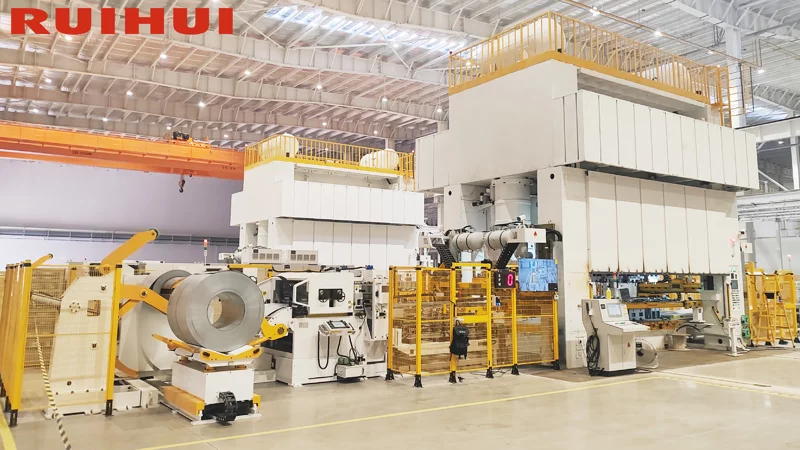
This is RUIHUI’s automated transfer press line, a high-precision, high-efficiency solution for mass metal stamping in automotive and hardware industries.
1. Basic Definition & Working Principle
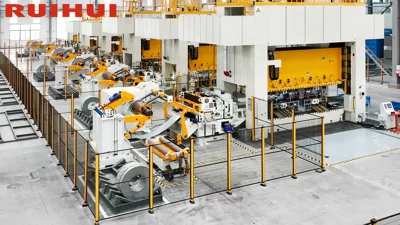
- It is essentially a single large-scale press integrated with multiple stamping stations, equipped with a built-in 3-axis transfer system (transfer rails/fingers) for synchronous workpiece handling.
- All production processes are completed inside one single press, featuring short conveying distance, high positioning accuracy and excellent synchronization performance.
- It supports both coil and sheet feeding methods, and is applicable to complex 3D forming processes.
(Fully Automatic 3-Axis Transfer Stamping Line)
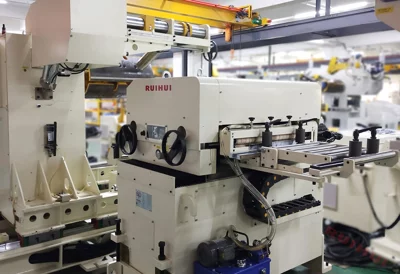
- Consists of multiple independent presses arranged in tandem, each equipped with one set of dies. Workpiece transfer between presses is realized via external 6-axis robots or gantry manipulators.
- Each press can operate independently with process parameters adjustable separately, which effectively avoids unbalanced equipment load compared with single multi-station presses.
- Adopting modular design, it allows users to add or remove presses and bypass specific working stations as required.
(6-axis Robot System Tandem Line)
2. Key Performance Comparison
| Parameters | Transfer Press Line | Tandem Press Line |
| Production Speed | Higher efficiency, built for high-volume output | Narrowed efficiency gap after servo upgrade |
| Flexibility | Low: For single part family; long, complex changeover | High: Fast adaption to varied parts; supports multi-model mixed production |
| Investment Cost | High: Large one-time cost for large press + integrated dies | Medium: Phased investment; start with 2-3 presses, scale gradually |
| Unit Cost | Low: Strong scale effect, ideal for long-term mass production | Medium: Cost-effective for frequent changeover, small/medium batches |
| Floor Space | Small: Compact, single integrated equipment layout | Large: More space needed for multiple presses + robotic systems |
| Maintenance Difficulty | High: High integration; single-point failure risks full-line shutdown | Low: Independent presses; separate maintenance without line disruption |
| Applicable Part Size | For medium/small complex parts, limited by press table size | Ideal for large exterior panels; expandable size via multi-press collaboration |
| Material Compatibility | Medium: Good for regular-thickness materials, strong deep drawing | High: Per-press parameter optimization for high-strength steel & special materials |
3. Advantages & Limitations
Advantages of Transfer Press Line
- Ultimate productivity: Synchronized multi-station operation minimizes conveying time and maximizes hourly output
- Superior cost performance: Ensures the lowest unit cost in long-term mass production, an optimal choice for cost-leading strategies
- Stable precision: Built-in transfer system delivers high positioning accuracy and consistent part quality, meeting strict tolerance requirements
- Space-saving design: Occupies less floor space, ideal for factories with limited workshop area
Limitations of Transfer Press Line
- Poor flexibility: Long model change time (usually several hours), not fit for frequent product switching
- High investment risk: Huge upfront investment may result in poor ROI if products have short service life
- Complicated maintenance: High integration demands professional technicians for repair with great production downtime impact
- Size restriction: Unable to process extra-large workpieces due to the limited table size of single press
Advantages of Tandem Press Line
- Outstanding flexibility: Robots can be reprogrammed rapidly to produce different parts and realize mixed production of various vehicle models
- Flexible capital arrangement: Production capacity can be expanded step by step to cut down initial investment risks
- Easy maintenance: Independent operation of each press enables separate maintenance and die replacement without interfering other stations
- Unlimited workpiece size: Capable of manufacturing large automotive body panels through multi-press coordinated operation
- Customized process optimization: Drawing, bending, punching and other individual processes can be parameterized separately to upgrade finished part quality
Limitations of Tandem Press Line
- Relatively lower production tempo compared with transfer press lines
- Larger floor occupation with higher workshop layout and logistics requirements
- Complex synchronous coordination: Precise control system is required for multi-device linkage with complicated initial commissioning
- Higher unit cost in ultra-large scale production scenarios
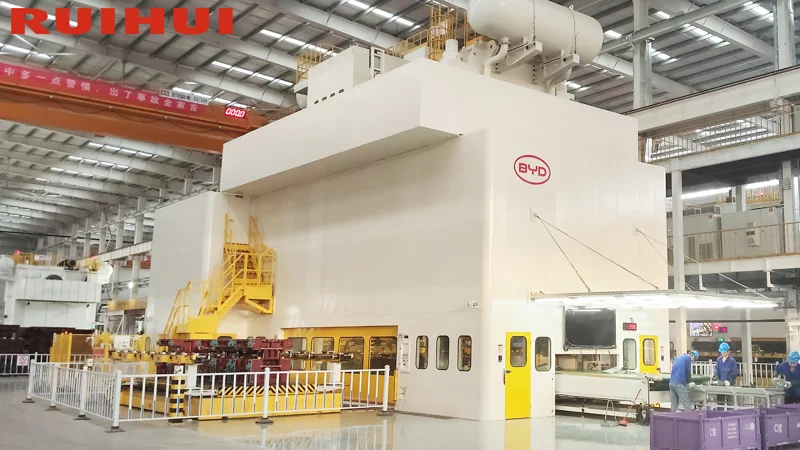
RUIHUI 3000T Transfer Press Line: Customized high-tonnage stamping for BYD automotive production.
4. Application Scenarios in Automotive Stamping Industry
Preferred Scenarios for Transfer Press Line
- Mass production of single-type components: Products with annual output over 100,000 pieces such as inner door panels, seat brackets and chassis structural parts
- Long-term stable production: Products with service life no less than 5 years and stable market demand
- Cost-sensitive projects: Enterprises prioritizing cost advantage and price competitiveness
- Medium & small-sized complex parts requiring multi-process precision forming
Preferred Scenarios for Tandem Press Line
- Mixed production of multiple vehicle types: Match multi-platform layout of automakers to produce various auto parts on one single line
- Frequent new product launch: Enterprises needing fast model switching capability for annual new vehicle release
- Large exterior body panels: Doors, engine hoods, trunk lids and other oversized auto body components
- Application of advanced materials such as HSS & UHSS: Processes requiring separate pressure and speed parameter optimization
- Phased capacity expansion: Enterprises with limited capital planning to boost production capacity along with market growth
5. Selection & Decision-Making Framework
Production Capacity & Product Variety Analysis
- Annual output ≥ 100,000 pieces with single product type: Prioritize Transfer Press Line
- Annual output < 100,000 pieces or more than 3 product types: Prioritize Tandem Press Line
Investment Payback Period
- Product service life ≥ 5 years: Transfer Press Line brings better investment return
- Product service life < 3 years: Tandem Press Line delivers higher flexible value
Existing Factory Conditions
- Limited workshop space: Choose space-efficient Transfer Press Line
- Existing idle presses available: Expand production with Tandem Press Line to improve equipment utilization
Industry Technology Trends
Modern servo drive technology has lifted the operating speed of tandem press lines up to over 20 SPM, narrowing the efficiency gap with transfer lines.
AI and digital twin technology further optimize synchronous control of tandem lines, greatly improving overall production efficiency and machining precision.
6. Conclusion & Final Recommendation
There is no one-size-fits-all superior solution, only the most suitable one. The selection of automotive stamping production lines shall be comprehensively determined based on corporate development strategy, product characteristics, market demand and financial status.
- Choose Transfer Press Line if you pursue scale effect and minimum unit cost, suitable for mass, long-cycle and single-variety auto parts manufacturing.
- Choose Tandem Press Line if you prioritize production flexibility and rapid market response, ideal for multi-variety, short-cycle production of large automotive body panels.
Contact RUIHUI engineering team immediately to obtain a customized solution white paper and take the key step towards cost reduction and efficiency improvement.
RUIHUI — Make Metal Forming Easier.
With years of hands-on experience, I have honed my skills in navigating the complexities of global commerce, offering invaluable insights and solutions to address customer needs. My commitment to excellence and dedication to customer satisfaction ensure that I deliver exceptional service, guiding clients through every step of the trading process with confidence and proficiency.


You may also like
Related News
Latest Update