

Robot Tandem Stamping Production Line – Fully Automatic Stamping for Automotive Body Sheet Metal
Share to : 


Automotive body sheet metal parts, such as doors, engine hoods, and fenders, are large in size, require multiple processing steps, and demand extremely high surface quality. Producing these parts has always been challenging. In the past, many factories used multiple presses with manual loading and unloading, where workers had to carry large and heavy panels between presses. Not only was this labor‑intensive and inefficient, but it also made accurate placement difficult, compromising quality and increasing safety risks. In recent years, robot tandem stamping production lines have been increasingly adopted for automotive body sheet metal, systematically addressing all these issues.
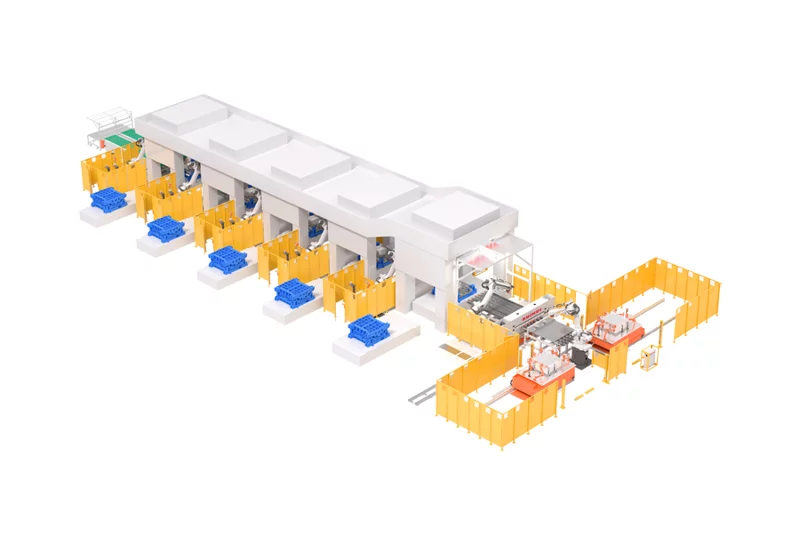
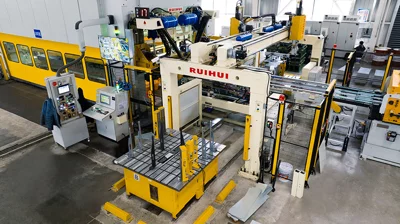
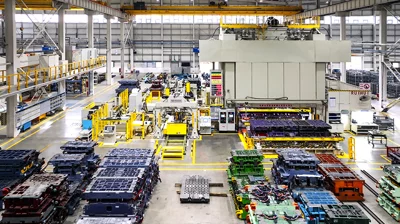
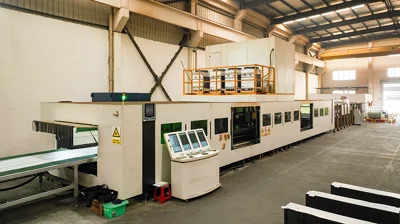
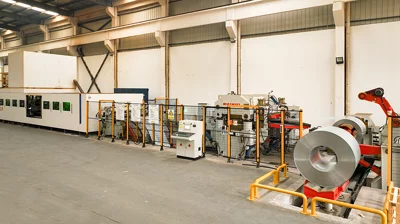
A robot tandem stamping line consists of multiple presses arranged in sequence according to the process steps, with each press performing one operation. Between every two presses, a six‑axis industrial robot handles part transfer—removing the workpiece from the die of the previous press and placing it into the die of the next. At the front end, destacking and feeding equipment supplies blanks to the first press; at the back end, collection and stacking equipment automatically gathers finished parts from the final press. From blank loading to finished part collection, the entire line runs fully automatically, with all intermediate handling performed by robots.
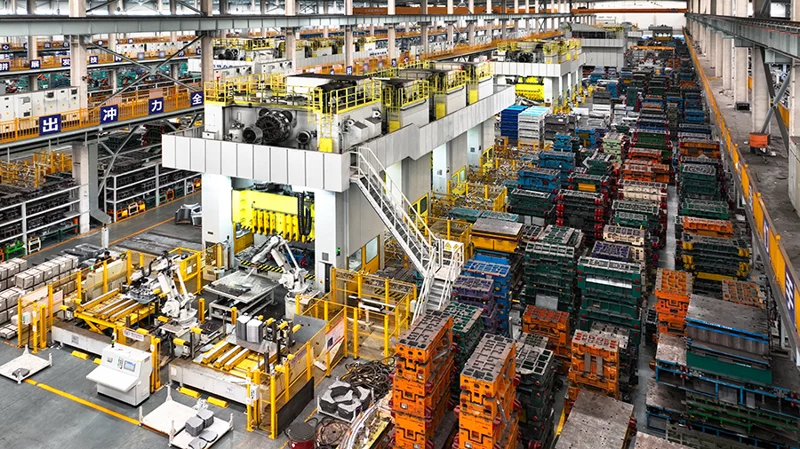
Why is the robot tandem line particularly suitable for automotive body sheet metal? First, because these large panels require many processing steps—a single press simply cannot accommodate that many dies. Body panels like side outer panels and roof panels use dies that are several meters long; fitting even two in one press is already tight, let alone five or six. Thus, using multiple presses, each handling a single operation, is dictated by the product itself. Second, automotive outer panels have extremely strict surface quality requirements—they cannot tolerate scratches or dents. Manual loading and unloading often results in accidental surface damage during handling. Robots use vacuum suction cups with multiple points of contact, applying force evenly without causing local deformation or surface scratches, which is far superior to manual handling. When workers lift large panels by hand, the grip points inevitably concentrate force, and thin panels can easily dent under pressure; robots, with their broad‑area suction cups, distribute the load evenly, leaving no marks.
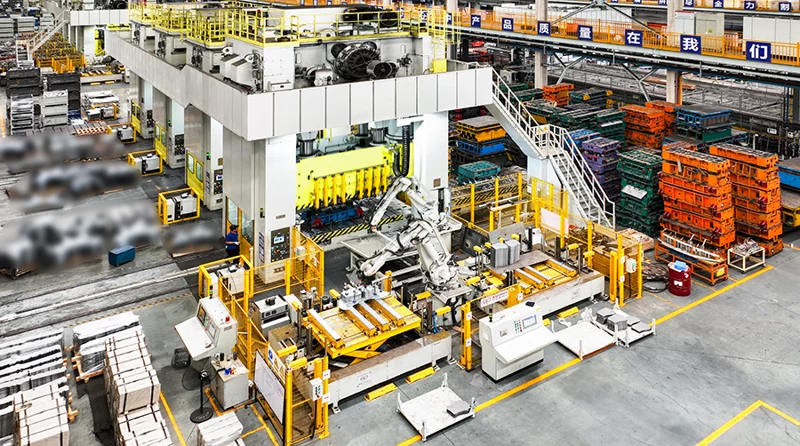
Another advantage of robots in automotive body sheet metal production is flexibility. A six‑axis industrial robot has six joints, offering high mobility and the ability to perform complex posture adjustments. Large panels often need to be flipped or reoriented between operations, and robots can handle these tasks with ease. For example, after the first operation (drawing), the panel becomes three‑dimensional; during the subsequent trimming operation, it must be placed into the die at a specific angle. The robot can flexibly adjust the workpiece's orientation and place it correctly into the die of the next press. Moreover, robot placement is precise and repeatable—every pick‑and‑place action is exactly the same, ensuring consistent part dimensions. With manual placement, each position varies slightly, often by a few millimeters, but body panels demand tight tolerances; a few millimeters of deviation can cause assembly misalignment later. Robots place parts with zero variation, ensuring excellent product consistency.
Once automated, robots do not tire and maintain a stable cycle time throughout continuous operation. Overall line efficiency is significantly higher than with manual handling, boosting production capacity while reducing workers' physical strain. When workers manually handle large panels, each lift takes tens of seconds, and fatigue slows them down over time—especially during night shifts. Robots, on the other hand, run at a consistent speed from start to finish, making the entire line's output stable and predictable.
Safety is another major advantage of robot tandem lines. The most dangerous aspect of a stamping shop is manual loading and unloading—especially on large presses with massive dies and high tonnage. Workers reaching into the die area to place or remove parts risk severe injury if the press misfires or if they make a mistake. Robot tandem lines completely replace human operators in hazardous areas. Workers only monitor the equipment from safe zones, with comprehensive safety interlocks between robots and presses, along with safety fences and light curtains, dramatically reducing workplace injury risks. From a safety perspective, using robots to replace humans in the die area fundamentally removes operators from dangerous environments.
When planning a robot tandem stamping production line, several factors must be carefully considered. First, the robot's payload capacity and reach must match the part size and weight—large panels are both big and heavy, requiring sufficient load capacity. Body panels range from a few kilograms to over twenty kilograms, and when you add the end‑of‑arm tooling, the total load is not insignificant. Reach must also be long enough to remove parts from the previous press and place them into the next. Second, the number of robots depends on the number of operations—one robot is needed between every two presses. Third, precise timing coordination between robots and presses is essential: when to pick, when to place, and when the press should cycle—all signal interactions must be accurate and reliable. Fourth, front‑end and back‑end equipment must be seamlessly integrated—destacking, feeding, collection, and stacking must be synchronized with the stamping line; if the front end feeds faster than the back end can receive, or too slowly causing idle waiting, the entire line suffers.
Guangdong RuiHui Intelligent Technology Co., Ltd. has over twenty years of experience in stamping automation. It is a national "Specialized and Sophisticated" "Little Giant" enterprise, headquartered in Dongguan, with more than 400 employees and over 80 R&D staff. RuiHui's robot tandem stamping production lines have been extensively applied in the automotive body sheet metal industry, with mature automation solutions for typical large panels such as doors, engine hoods, and fenders. They can configure six‑axis industrial robots based on product characteristics and cycle time requirements, integrating the entire line from front‑end destacking and feeding to back‑end part collection and stacking. RuiHui has supplied body sheet metal stamping automation lines to numerous automotive OEMs and first‑tier suppliers, with nearly 5,000 sets of equipment operating at customer sites both domestically and internationally. Their equipment has served well‑known companies including BYD, Geely, Volkswagen, Tesla, BMW, Mercedes‑Benz, Honda, and Land Rover Jaguar, giving them extensive experience in fully automatic stamping of automotive body sheet metal.
Automotive body sheet metal production is ultimately about quality, cycle time, and safety. The robot tandem stamping production line, by replacing manual handling with automation, delivers on all three fronts—making it the mainstream direction for fully automated production of automotive outer panels.
With years of hands-on experience, I have honed my skills in navigating the complexities of global commerce, offering invaluable insights and solutions to address customer needs. My commitment to excellence and dedication to customer satisfaction ensure that I deliver exceptional service, guiding clients through every step of the trading process with confidence and proficiency.