

Single-Press Multi-Station Stamping Line – Sheet Metal Processing Solution for New Energy Battery Enclosures
Share to : 


In recent years, demand for new energy battery enclosures has grown rapidly. As the outer shell of battery packs, these enclosures have stringent requirements for dimensional accuracy, material quality, and surface finish. Sheet metal processing for battery enclosures differs from ordinary stamped parts in several notable ways: first, precision requirements are high—battery enclosures undergo subsequent welding and assembly, and inconsistent dimensions will prevent proper fit; second, the materials are quite specific, often aluminum or special coated steels, which require careful handling to avoid scratches; third, production volumes are large, often running in mass quantities. These characteristics dictate that the stamping automation solution for battery enclosures must be specially designed.
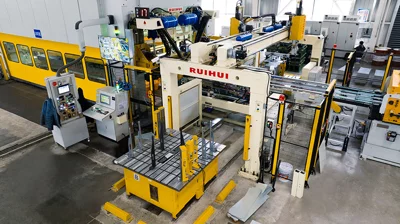
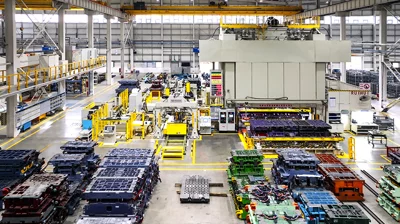
The single‑press multi‑station stamping line is a widely adopted solution for battery enclosure sheet metal processing. The concept is to consolidate all stamping operations for the battery enclosure onto a single large‑tonnage press, using multiple dies corresponding to multiple process steps, with a 3D multi‑station transfer robot responsible for transferring workpieces between stations. From sheet loading to finished part removal, the entire stamping process is completed within one press.
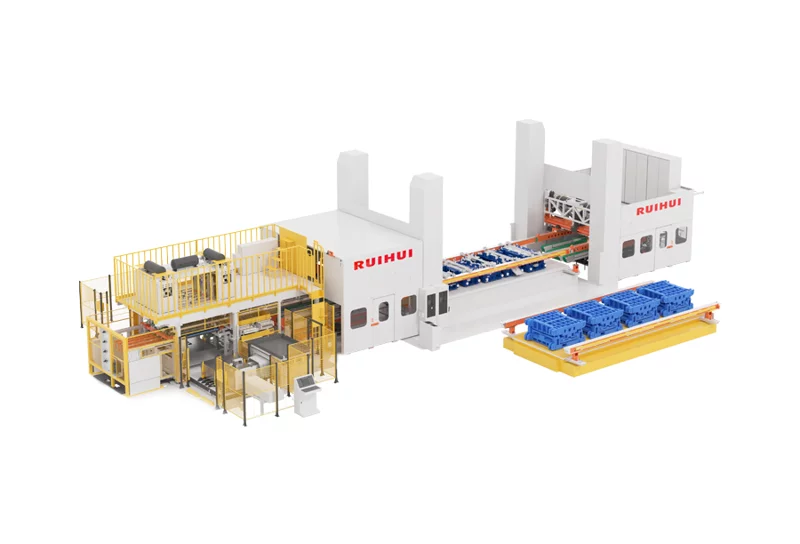
Why is the single‑press multi‑station approach suitable for battery enclosures? First, because the process steps can be arranged within one press—operations such as blanking, piercing, drawing, and restriking are sequenced in order, and a single press with a 3D transfer robot can handle all of them. The 3D transfer robot has three‑axis motion capability, allowing it to move between multiple stations inside the press, reach into dies to pick and place parts, and transfer workpieces from one station to the next. Second, in terms of precision and consistency, battery enclosures demand high dimensional accuracy. Manual loading and unloading result in inconsistent part placement, leading to out‑of‑tolerance parts. The 3D transfer robot offers high repeat positioning accuracy, ensuring that every workpiece is placed into the die in exactly the same position, guaranteeing product consistency.
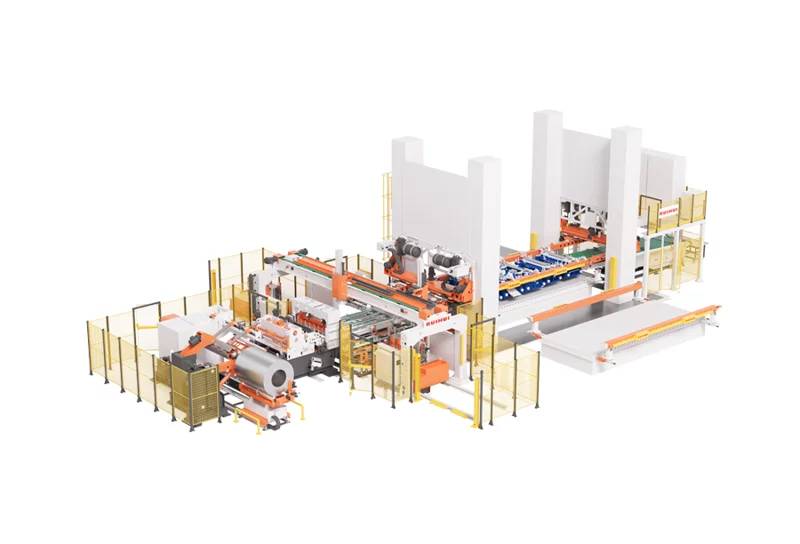
Material protection is another critical aspect of battery enclosure processing. Many enclosures are made of aluminum—soft and prone to scratching. Scratches must be avoided during stamping and handling, as they can affect both appearance and subsequent service life. The 3D transfer robot's smooth pick‑and‑place motion, combined with end‑effectors designed with protective features tailored to the workpiece, minimizes damage to the parts.
The single‑press multi‑station line also offers advantages in floor space and labor requirements. Although battery enclosure stamping involves large volumes, all operations are concentrated on one press, occupying less workshop area. One operator can run the line, mainly responsible for loading and monitoring—a practical solution for factories with limited shop floor space.
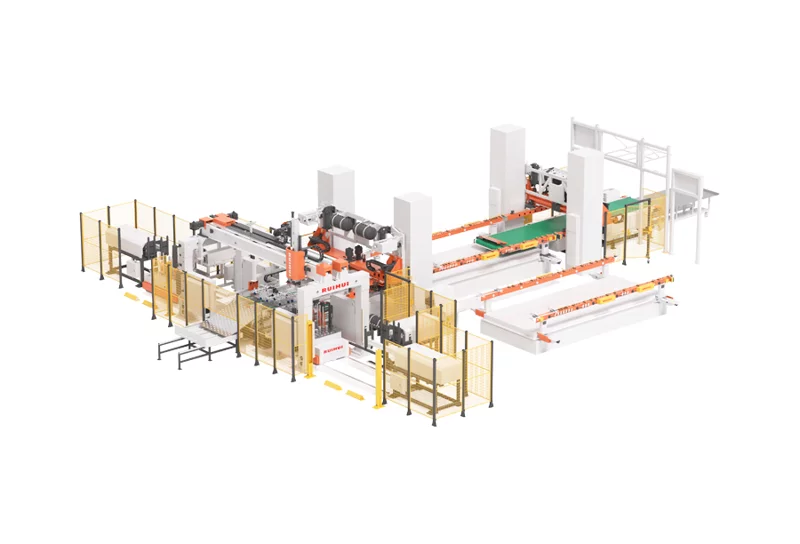
It should be noted that whether to use a single‑press multi‑station line or a multi‑press tandem line depends on the user's existing layout and process planning. The decision is based on the part's process characteristics and the number of operations required—you first plan the press and die arrangement, then select the appropriate automation. Battery enclosures come in various sizes; some can be fully processed on a single press, making a single‑press multi‑station line ideal. Others are larger or require more steps that cannot fit on one press, so multiple presses in tandem are considered. The key is to match the process requirements.
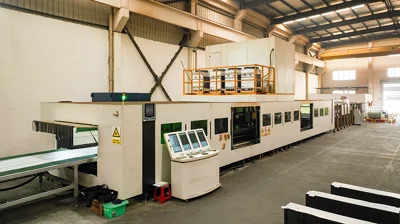
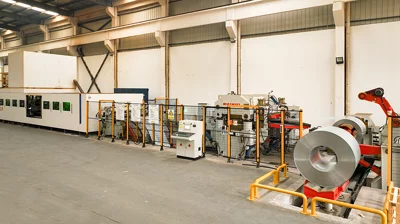
When designing a processing solution for new energy battery enclosures, front‑end feeding and back‑end part collection must also be considered. For sheet blanks, a destacker is used; for coil stock, a feeder is provided. At the back end, an automatic part collection system gathers finished parts after stamping. The entire line—from sheet loading to finished part collection—forms a complete automated workflow.
Guangdong RuiHui Intelligent Technology Co., Ltd. has over twenty years of experience in stamping automation. It is a national "Specialized and Sophisticated" "Little Giant" enterprise, headquartered in Dongguan, with more than 400 employees and over 80 R&D staff. RuiHui has invested substantial R&D resources in the new energy sector, developing dedicated automated production line solutions for new energy battery enclosure stamping—covering loading, destacking, conveying, workpiece transfer, and line‑end collection with mature supporting equipment. RuiHui's 3D multi‑station transfer robots are widely used in stamping lines for automotive parts, home‑appliance sheet metal, and 3C hardware, and can be customized according to the battery enclosure's dimensions, process steps, and material characteristics. RuiHui has supplied complete stamping automation line solutions to numerous new energy component manufacturers, with nearly 5,000 sets of equipment operating at customer sites both domestically and internationally. Their equipment has served well‑known OEMs and first‑tier suppliers including BYD, Geely, Volkswagen, Tesla, BMW, Mercedes‑Benz, Honda, and Land Rover Jaguar, giving them extensive hands‑on experience in the new energy field.
Battery enclosure processing demands high precision, material protection, and production capacity. The single‑press multi‑station stamping line reliably meets these requirements through automation, making it a dependable choice for sheet metal processing of new energy battery enclosures.
With years of hands-on experience, I have honed my skills in navigating the complexities of global commerce, offering invaluable insights and solutions to address customer needs. My commitment to excellence and dedication to customer satisfaction ensure that I deliver exceptional service, guiding clients through every step of the trading process with confidence and proficiency.