

Slitting Lines Enable Precision Strip Slitting for High‑Efficiency Production
Share to : 


Some stamping shops don't need full sheets—they need narrow strips. Silicon steel strips for motor stators and rotors, copper strips for transformers, and coil stock for progressive stamping dies—all these narrow strips are produced by slitting lines that cut a wide coil into dozens of narrow strips and then rewind them into small coils. That's exactly what a slitting line does.
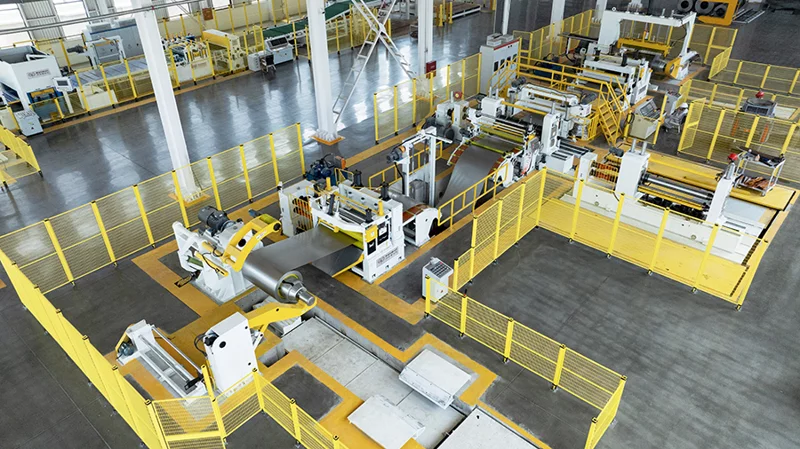
Precision slitting is the core capability of a slitting line. Slitting accuracy is typically required to be held within very tight tolerances. For materials like silicon steel, even a slight deviation can cause problems in subsequent motor winding. When silicon steel laminations are stacked to form a motor core, every strip must be exactly the same width. If one strip is wider by just a few tenths of a millimeter, the entire core's outer diameter becomes out‑of‑round, leading to increased vibration and noise when the motor runs. Achieving this level of precision demands a sufficiently rigid arbor system, precisely adjusted blade clearances, and stable rewind tension control. Any slack in any of these areas will result in inconsistent strip widths. The arbor is the most critical component of the slitter—its rigidity directly determines slitting accuracy. If the arbor deflects or bends under cutting forces, the distance between the blades changes, and the slit strips will inevitably have incorrect widths. That is why high‑quality slitting lines use large‑diameter arbors made from specially treated alloy steel.

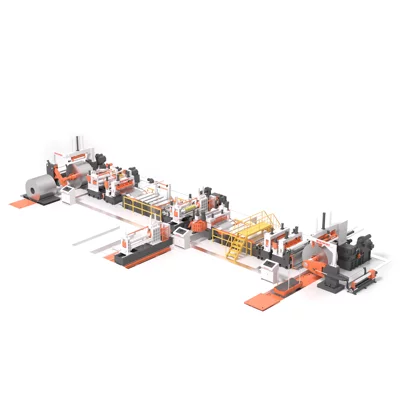
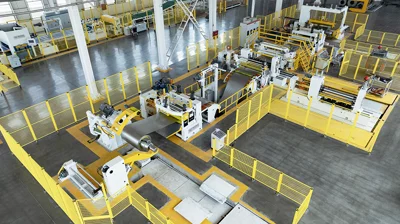
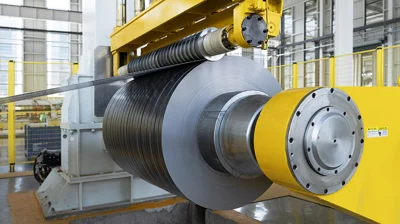
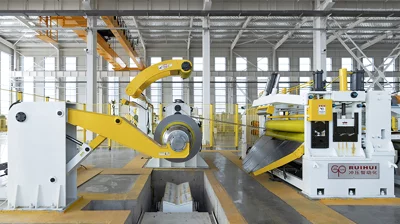
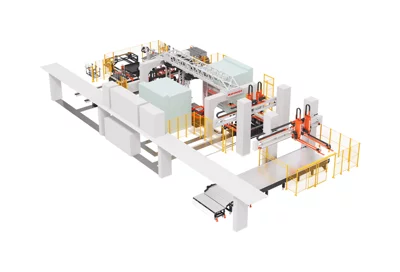
The working sequence of a slitting line is as follows: the loading trolley lifts the coil and delivers it to the decoiler; the decoiler unwinds the coil; circular slitter knives longitudinally cut the wide strip into multiple narrow strips; the scrap edge winder removes the irregular edges; and the recoiler rewinds the qualified narrow strips into small coils. The entire process runs continuously—once a coil is loaded, the machine keeps running, producing neat rows of narrow‑width coils at the exit. The circular slitter knives are the parts that directly contact and cut the material. Their material, angle, and clearance all directly affect cut quality. Carbide blades are used for silicon steel, coated blades for aluminum, and tool steel blades for ordinary steel—matching the blade type to the material is basic common sense when selecting a slitting line.
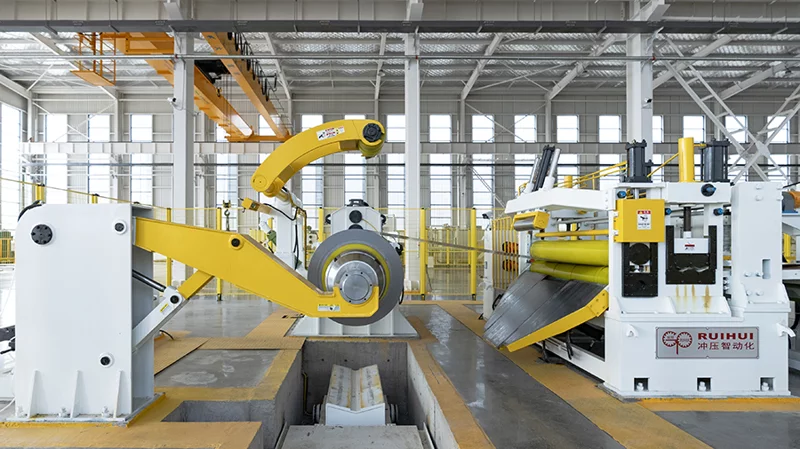
Heavy‑gauge slitting and light‑gauge slitting have different equipment requirements. Thick plates require higher shearing forces, so the arbor and frame must be more rigid, and the hydraulic system pressure must be matched accordingly. When slitting thick plates, the blades experience significant lateral forces; if the arbor lacks sufficient rigidity, the blades can be forced apart, causing the slit edges to be non‑straight. Thin plates—especially silicon steel—are brittle and hard, imposing higher demands on blade material and clearance; otherwise, burrs are likely to appear at the cut edges. Burrs are the most feared defect in thin‑gauge slitting, because they not only affect downstream use but can also scratch adjacent layers during rewinding, scrapping an entire coil. When selecting equipment, be sure to clearly specify the material, thickness, and width you will process, so that the supplier can configure appropriate blade materials and tension control parameters accordingly.
The efficiency of a slitting line lies in its ability to "accomplish multiple tasks in one pass." Traditionally, strips had to be cut one at a time; a slitting line cuts dozens at once. Moreover, with an automatic knife positioning system, changeovers no longer require workers to manually adjust each blade position with a wrench—the system automatically calculates and positions the knives, quickly and accurately. The automatic knife positioning system stores position parameters for various specifications; when a new specification is entered, the system automatically calculates the new positions for each blade and drives the motors to adjust them in place—all within minutes.
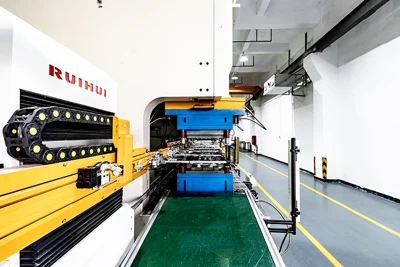
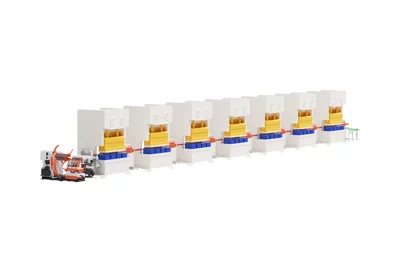
Guangdong RuiHui Intelligent Technology Co., Ltd.'s slitting line solutions emphasize the synergy of the entire system. The four stages—decoiling, slitting, rewinding, and scrap edge collection—are designed as an integrated whole to ensure speed and tension matching across all stages. Particularly for scenarios where the slitting line is linked to a stamping line, RuiHui pays special attention to whether the narrow coils produced can be fed directly into the presses. With nearly 5,000 sets of equipment delivered, RuiHui has accumulated extensive experience and offers mature solutions for slitting a wide variety of materials.
With years of hands-on experience, I have honed my skills in navigating the complexities of global commerce, offering invaluable insights and solutions to address customer needs. My commitment to excellence and dedication to customer satisfaction ensure that I deliver exceptional service, guiding clients through every step of the trading process with confidence and proficiency.