

Slitting Line Automated Processing Solution for Metal Coil Uncoiling Slitting and Rewinding
Share to : 


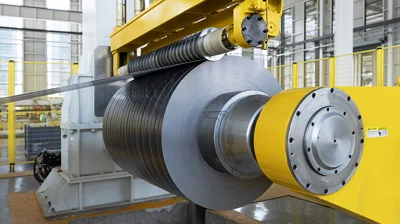
In the metal processing industry, we frequently encounter this scenario: steel mills produce coils with fixed widths—say 1 meter or 1.2 meters—but our production lines require narrow coils of 200mm or 300mm width. This is where the "slitting line"—also known as a "strip dividing line"—comes in. Its task is to slit wide coils into multiple narrow strips, serving as a vital bridge between steel mills and end users.
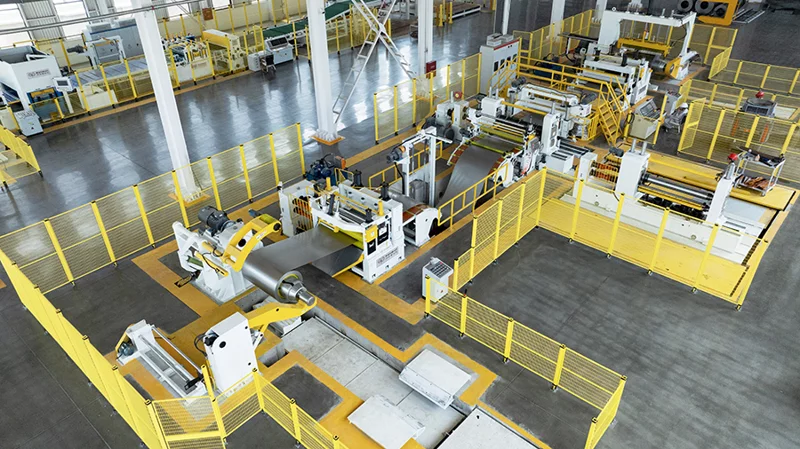
The Workflow of a Slitting Line
A complete slitting line follows a clear and straightforward process:
Loading: The loading carriage smoothly delivers the heavy coil to the uncoiler.
Threading and Initial Leveling: The coil head is fed into the equipment and passes through an initial leveler to remove major curvature.
Slitting: This is the core step. The sheet passes through a set of upper and lower staggered circular blades, which longitudinally cut it—like scissors—into multiple narrow strips.
Tension Control and Separation: The slit strips must be separated to prevent scratching each other, while tension control keeps them stable.
Rewinding: Finally, the multiple narrow strips are separately wound into small coils.
The Core Lies in "Stability" and "Precision"
A slitting line may appear simple, but achieving high-quality results is not easy—the key lies in "stability" and "precision."
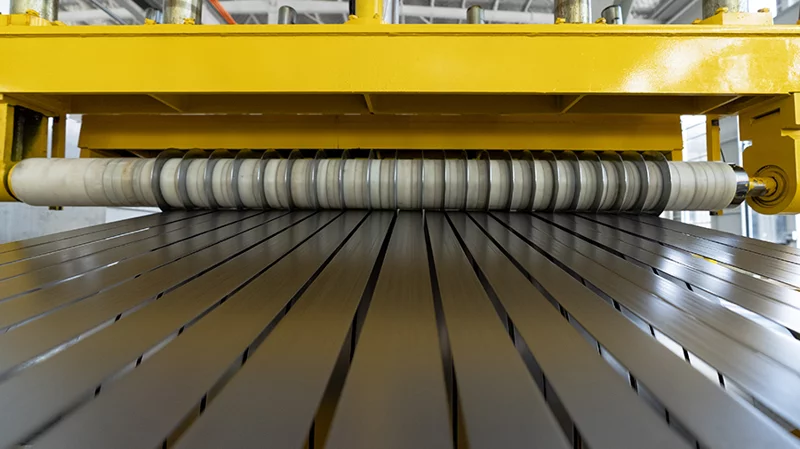
Stability: This refers to smooth operation. From uncoiling to rewinding, the entire line must maintain constant tension. If tension is unstable, the strip will deviate, wrinkle, or even break. This is especially critical for thin materials such as 0.1mm copper foil or aluminum foil, where tension control is paramount.
Precision: This refers to dimensional accuracy. First, the slit width must be accurate, which depends on the precision of the circular blades and their installation. Second, the rewind must be even—avoiding the "cone coil" phenomenon where one side is tighter than the other, as that will cause problems in subsequent use.
Automation Is the Trend
Older slitting lines require manual threading, manual spacer ring placement, and manual coil unloading—labor-intensive and inefficient. Modern automated slitting lines are entirely different:
Automatic threading: Assisted by belts or chains, the material is automatically fed without manual pulling.
Hydraulic or pneumatic spacers: Blade clearances and spacer positions are automatically adjusted for quick specification changes.
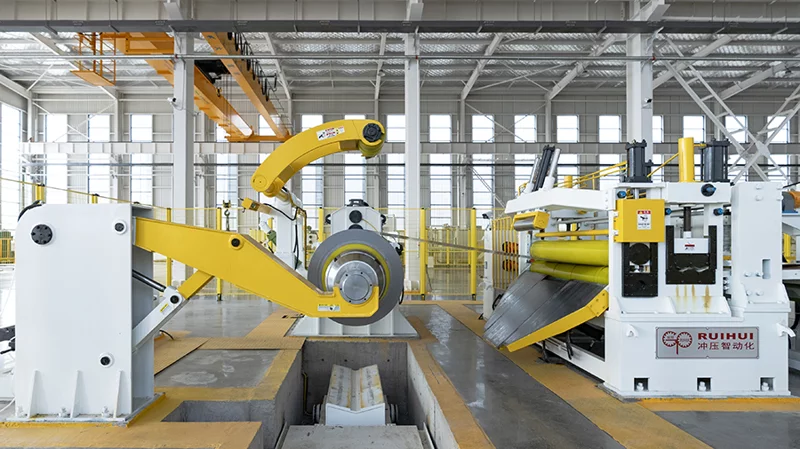
Automatic coil unloading: After rewinding is complete, an unloading carriage automatically removes the finished coil and applies tape—eliminating heavy manual handling throughout the process.
Wide Range of Applications
Slitting lines have very broad applications, covering nearly all industries that use metal coils:
Automotive industry: Supplying different widths of sheet stock for stamping lines.
Home appliance industry: Slitting galvanized and pre-painted sheets used for refrigerator and washing machine housings.
Building materials industry: Slitting steel strips for framing, corrugated sheets, and more.
Battery industry: Precision slitting of aluminum, copper, and steel strips for new energy battery tabs and casings. RuiHui's servo slitting lines for the battery industry place special emphasis on burr control and surface protection to meet the high standards of battery products.
Selection Considerations
When choosing a slitting line, several key parameters must be defined:
Material: Is it carbon steel, stainless steel, aluminum, copper, or silicon steel? Different materials have different strength and ductility properties, requiring different equipment rigidity and blade materials.
Specifications: Maximum coil weight, thickness range, and finished strip width range.
Precision requirements: Required tolerances for slit width and rewind neatness.
Automation level: Determine the degree of automation needed based on production volume and labor costs.
Conclusion
The slitting line is the "first step" in metal coil value-added processing, and its output quality directly affects downstream production. An efficient, stable, and automated slitting line not only improves material utilization but also significantly reduces labor costs—making it an essential tool for metal processing companies to enhance their competitiveness.
Guangdong RuiHui Intelligent Technology Co., Ltd., headquartered in Dongguan, specializes in the R&D and manufacturing of complete metal forming automation equipment. Their three-in-one feeders and complete line solutions have mature applications in automotive parts, appliance sheet metal, 3C hardware, new energy, and other industries, providing reliable stamping automation equipment to thousands of well-known enterprises both domestically and internationally.
With years of hands-on experience, I have honed my skills in navigating the complexities of global commerce, offering invaluable insights and solutions to address customer needs. My commitment to excellence and dedication to customer satisfaction ensure that I deliver exceptional service, guiding clients through every step of the trading process with confidence and proficiency.
You may also like
Related News
Latest Update