

Slitting Line Retrofit Solution for Improved Strip Slitting Quality
Share to : 


Many stamping plants have slitting lines that have been in service for quite a few years. The equipment still runs, but the slitting quality no longer meets today's product requirements. Issues like unstable strip width, excessive burrs, and untidy rewinding are becoming increasingly prominent. Replacing the entire line with a new one represents a significant investment—so is there a way to bring old equipment up to speed through retrofitting? The answer is yes, and at a much lower cost than buying a new line.
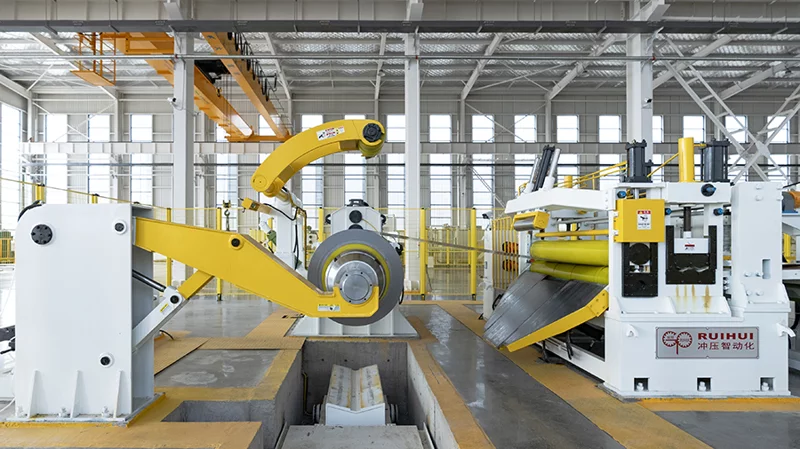
Retrofitting an old slitting line typically starts with several key areas. The first is the loading system. Older slitting lines relied on manual centering when loading coils. If the coil was placed off‑center, the subsequent slitting widths would be off as well. Manual centering depended entirely on the operator's experience and eyesight, and each coil had a slightly different position, leading to inconsistent slit widths. Today, an automatic centering system can be added to the decoiler. Using photoelectric sensors or hydraulic correction devices, it keeps the coil centered throughout the unwinding process, which directly improves slitting accuracy. The photoelectric centering system uses a pair of sensors to detect the coil edge position; the control system then drives hydraulic cylinders to adjust the decoiler position, maintaining alignment between the coil centerline and the arbor centerline. This retrofit requires a modest investment but yields noticeable improvements in slitting precision.
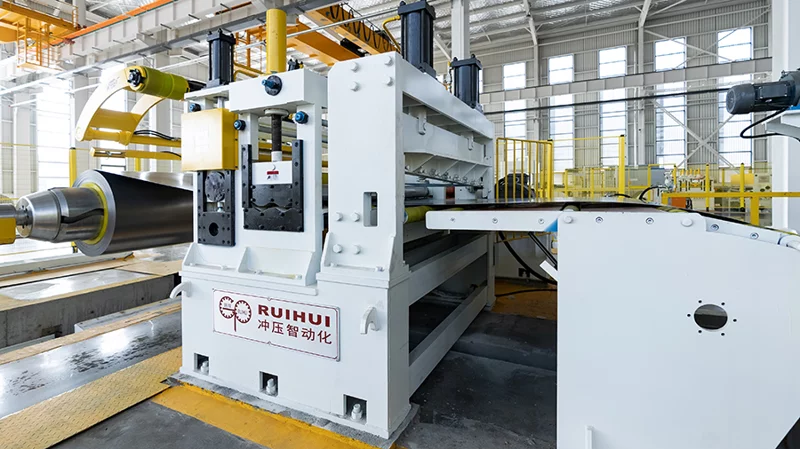
The second area is the tension control system. Tension stability is critical to slitting quality. Old equipment using standard variable‑frequency motors tends to have large tension fluctuations, resulting in loose, unevenly wound narrow coils with messy edges. Unstable tension also causes the strips to sway during slitting, producing non‑straight cut edges. Replacing it with a servo‑driven tension control system significantly improves tension accuracy, as well as rewind neatness and edge quality. Especially at high speeds, the servo system responds much faster than conventional variable‑frequency drives, enabling real‑time tension adjustments without the slack‑tight fluctuations. The core of the servo tension system is a high‑precision tension sensor that continuously measures strip tension and feeds it back to the controller; the controller automatically adjusts the rewind motor torque according to the set value, forming a closed‑loop control. Tension accuracy can reach a very high level.
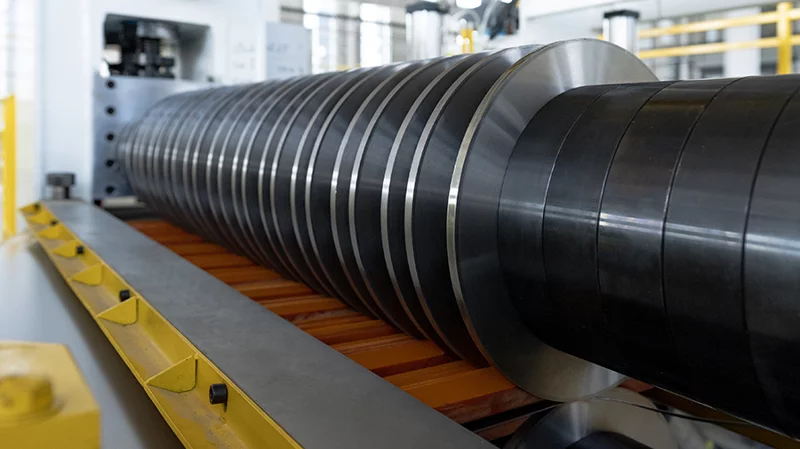
The third area is the arbor positioning system. In the past, when changing specifications, workers had to manually adjust each blade position with a wrench—a slow and error‑prone process. Manual adjustment not only took a long time but also introduced positioning errors each time, resulting in poor repeatability. Now, an automatic knife positioning system can be added: you input the coil width and the number of strips required, and the system automatically calculates the blade positions and drives motors to adjust them precisely. After the retrofit, changeover time is reduced from hours to minutes, and positioning repeatability is far superior to manual work. The automatic knife positioning system also includes position detection, displaying each blade's actual position on the screen so operators can visually confirm that all blades are correctly set.
The fourth area is scrap edge handling. Old slitting lines often use outdated scrap collection methods, leading to tangling and jamming that disrupt continuous operation. Once scrap edges become entangled around a roller, the entire rewind system can lock up, requiring a production stop for cleaning. Some retrofit solutions address this by adding servo tension control and restructuring the control logic to automate edge scrap winding, improving flow and reducing the need for manual intervention.
Retrofitting an old slitting line is not just about swapping parts—it's about targeted upgrades to the core factors that limit slitting quality. By pinpointing the bottlenecks, you can breathe new life into old equipment at a relatively small cost.
When undertaking slitting line retrofits, Guangdong RuiHui Intelligent Technology Co., Ltd. first conducts a comprehensive assessment of the customer's existing equipment to identify the key constraints on slitting accuracy, and then proposes a targeted retrofit plan. RuiHui's philosophy is to upgrade rather than replace whenever possible, helping customers achieve performance improvements with a reasonable investment and keeping their old equipment productive.
With years of hands-on experience, I have honed my skills in navigating the complexities of global commerce, offering invaluable insights and solutions to address customer needs. My commitment to excellence and dedication to customer satisfaction ensure that I deliver exceptional service, guiding clients through every step of the trading process with confidence and proficiency.