

Can Laser Blanking Lines Handle Irregular Edge Trimming for Automotive Body Panels
Share to : 


Blanking for automotive body panels has always been a step in stamping production. The traditional method uses die blanking—one die corresponds to one product, with long die-making lead times, and changing products requires changing dies. In recent years, laser blanking lines have become increasingly popular, and many people ask: can laser blanking lines handle irregular edge trimming for automotive body panels? The answer is yes—and this is precisely where laser blanking lines excel.
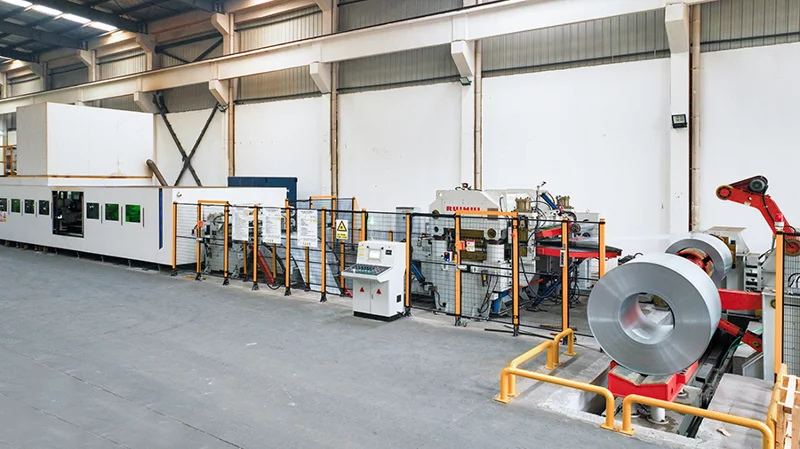
Why is irregular edge trimming a strength of laser blanking lines? Because laser cutting does not require dies; the cutting path is entirely controlled by the program. Whatever shape the part needs, you simply draw it on the computer and import the program. Rectangles, trapezoids, arcs, irregular contours—as long as the program can draw it, the laser can cut it. Blanks for automotive body panels often are not regular rectangles; they have various curves and bevels. Traditional die blanking would require an irregular-shaped die, which is costly and time-consuming. Laser blanking lines require none of this—this is their most obvious advantage.
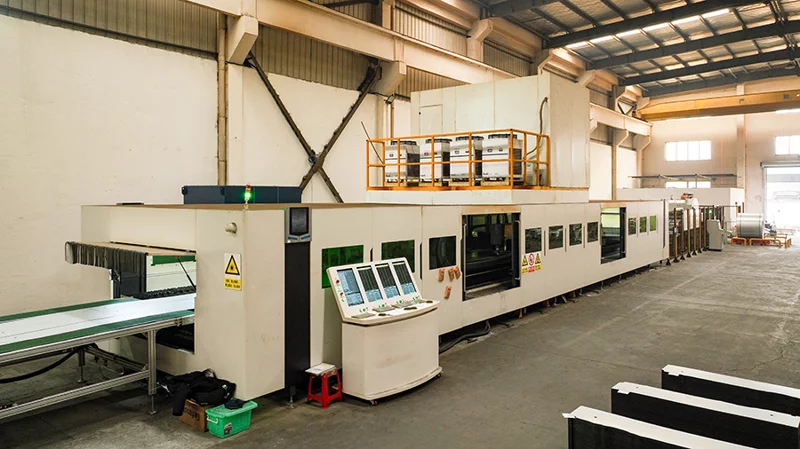
There are also several practical benefits to irregular edge trimming for automotive body panels. One is common-edge cutting. When nesting irregular parts, they can be arranged as compactly as possible, with adjacent part contours sharing a single cut line—saving both material and cutting time. The computer-automated nesting on a laser blanking line can optimize nesting for irregular parts, achieving significantly higher material utilization than traditional die blanking.
Another benefit is fast changeover. Automotive body panels are updated frequently; model facelifts and part redesigns are common. With traditional die blanking, changing a shape requires making a new die—a process that takes months, which new products cannot afford to wait for. With a laser blanking line, changing products means changing the program. It takes only minutes to switch from cutting Part A to Part B. Modifications are also easy—just modify the program to cut the new shape. For automotive production with rapid model iteration, this advantage is extremely obvious.
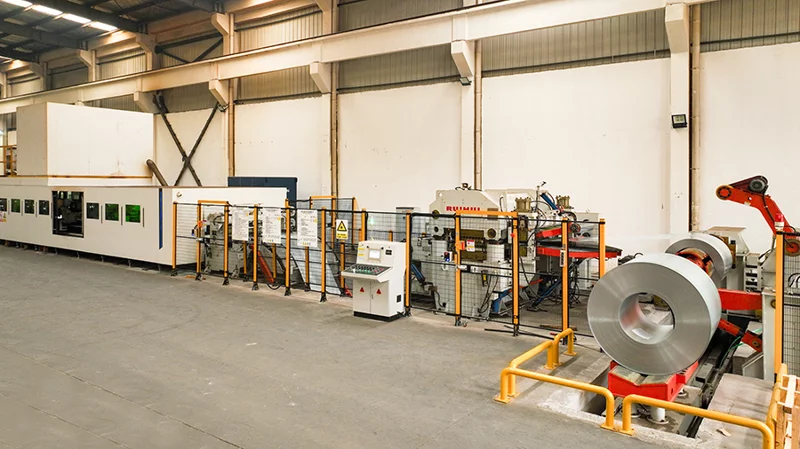
Yet another benefit is cut quality. Laser cutting produces a narrow kerf and a small heat-affected zone, with smooth edges and few burrs. The edge quality of body panel blanks directly affects subsequent forming. Fewer burrs mean smoother subsequent stamping and less post-processing work.
Of course, when using a laser blanking line to cut automotive body panels, several practical factors must be considered. First, cutting speed. Automotive body panels are large, and the cutting path is long. Laser power must be sufficient for cutting speed to keep up with the cycle time. Second, feeding accuracy. Body panel blanks have high dimensional accuracy requirements, so the feeding mechanism must be stable for accurate cutting positions. Third, sheet material. Automotive body panels use many types of sheet—carbon steel, high-strength steel, and aluminum. Laser parameters must be able to adapt to different materials.
One more point should be clarified: laser blanking lines are suitable for blanking and edge trimming of body panel blanks—that is, cutting coil or sheet into blank shapes. The cut blanks are then sent for stamping. These are two sequential processes. Laser blanking makes the blanking step flexible and efficient, while the subsequent stamping follows the original process. Working together, the two can significantly improve the production efficiency of automotive body panels.
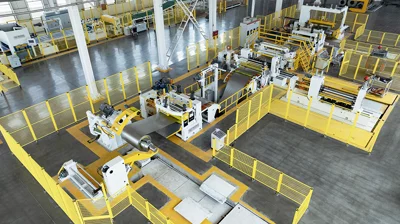
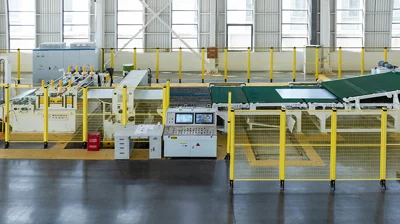
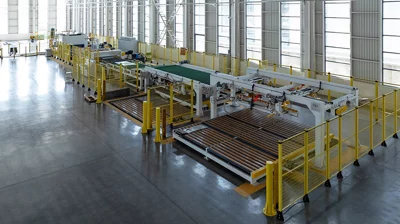
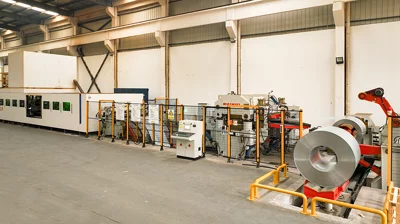
Guangdong RuiHui Intelligent Technology Co., Ltd. has been deeply engaged in the field of stamping automation for over twenty years. It is a national "Specialized and Sophisticated" "Little Giant" enterprise, headquartered in Dongguan, with more than 400 employees and over 80 R&D personnel. RuiHui's laser blanking lines are maturely applied in the automotive industry. For the cutting needs of irregular blanks for automotive body panels, they provide complete line solutions from decoiling, leveling, and servo feeding to laser cutting, sorting, and stacking. The cutting path is program-controlled, supporting common-edge cutting and automatic nesting. Laser power and feeding accuracy can be customized according to sheet material and dimensions. RuiHui has nearly 5,000 sets of equipment operating at customer sites both domestically and internationally, serving well-known OEMs and first-tier suppliers such as BYD, Geely, Volkswagen, Tesla, BMW, Mercedes-Benz, Honda, and Land Rover Jaguar, with rich experience in automotive sheet metal processing.
With years of hands-on experience, I have honed my skills in navigating the complexities of global commerce, offering invaluable insights and solutions to address customer needs. My commitment to excellence and dedication to customer satisfaction ensure that I deliver exceptional service, guiding clients through every step of the trading process with confidence and proficiency.
You may also like
Related News
Latest Update