

What Is a Palletizer Detailed Explanation of the Working Principle of Automatic Sheet Stacking
Share to : 


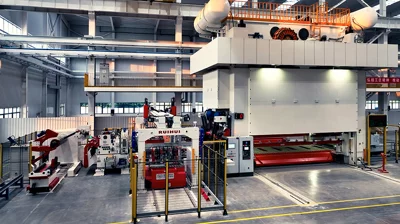
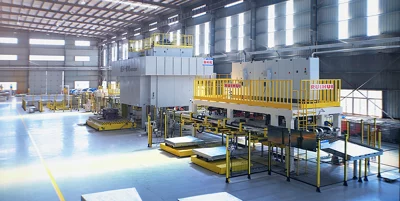
In stamping plants and sheet metal processing workshops, the palletizer is a piece of equipment that may not look impressive but is indispensable. Its task is to automatically stack finished parts or sheets neatly, eliminating the need for manual handling one sheet at a time. Palletizers usually do not exist on their own—they are end-of-line equipment for cut-to-length lines, blanking lines, and laser blanking lines.
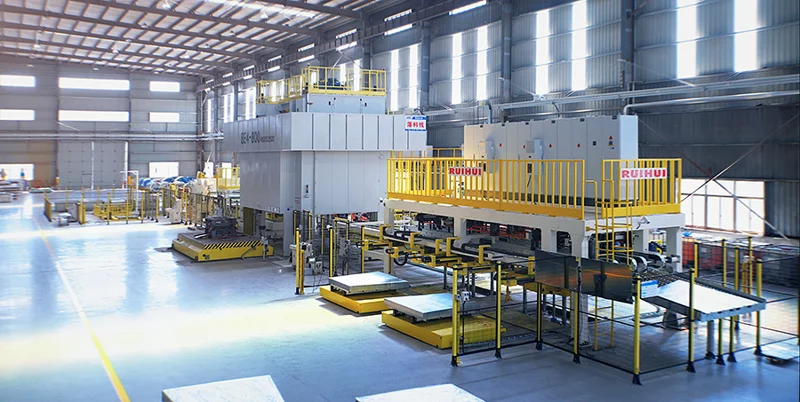
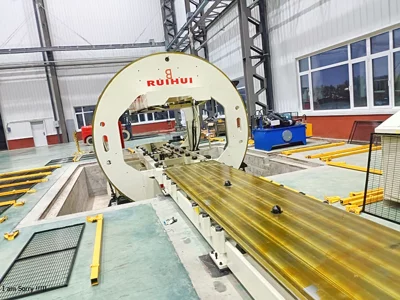
How does a palletizer work? Simply put: sheets exit from the previous process and are conveyed to the stacking area by a conveyor belt or magnetic belt. Then, through a physical method, the sheets automatically drop onto a receiving trolley and are stacked into a pile. The entire process requires no manual intervention. The palletizer is standard equipment at the end of cut-to-length lines, blanking lines, and laser blanking lines. It directly collects and stacks the cut or blanked sheets neatly, making them easy to retrieve for the next process or ship directly.
There are two main types of palletizers: gravity palletizers and magnetic palletizers. The two have different structures and are suited to different scenarios.
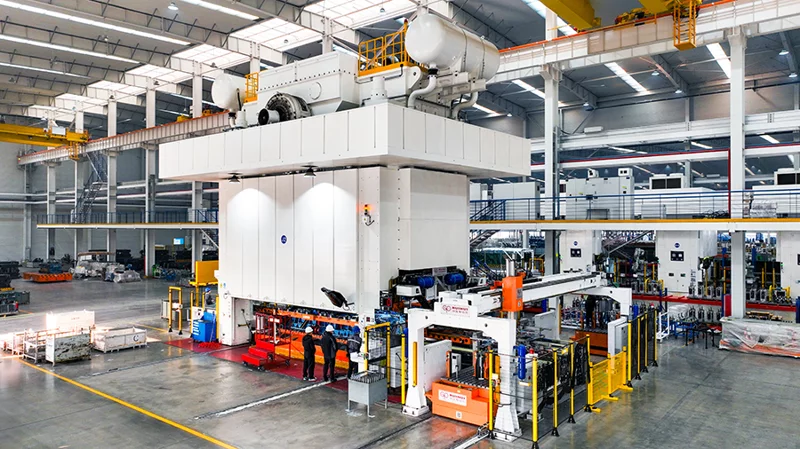
The gravity palletizer is a common type. After sheets exit the end of the conveyor belt, they fall freely under their own gravity onto the receiving trolley. To stack them neatly, aligning devices are usually installed around the receiving trolley—after a sheet falls, cylinders or stops on all four sides gently tap the edges of the sheet to align it. The receiving trolley has a lifting function and automatically lowers as the stack height increases, keeping the topmost sheet at a constant height. The advantage of the gravity palletizer is speed: the conveyor feeds continuously, and sheets drop continuously, making it ideal for high-volume, fast-paced production. The disadvantage is that sheets may suffer impacts during free fall, which can affect surface quality, making it unsuitable for materials with high surface requirements.
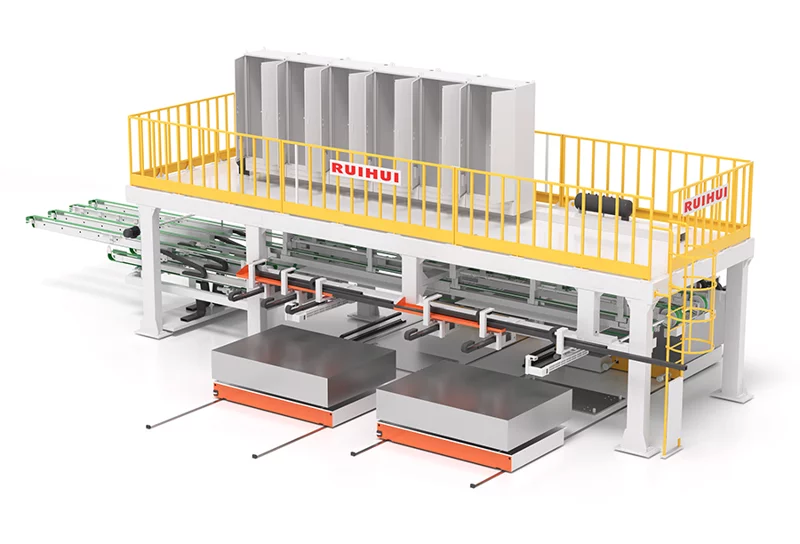
The magnetic palletizer uses a magnetic conveyor belt. After sheets exit the shearing or cutting equipment, they are conveyed on a magnetic belt. Magnetic force holds the sheets against the belt surface and transports them smoothly to the stacking position. When they reach a position above the receiving trolley, the magnetic force is released, and the sheets drop gently onto the trolley. The advantages of magnetic palletizing are: the sheets are held by magnetic force throughout the conveying process, so they do not slip or shift, and they land in a more accurate position. There is also no free-fall impact, so the sheet surface is better protected. However, magnetic palletizing requires the sheets to be magnetic—ordinary carbon steel and silicon steel work, but non-magnetic materials such as aluminum, copper, and stainless steel are not suitable. Magnetic palletizing also has another feature: it can handle sheets of various shapes. Whether square, round, or irregular, magnetic force holds them securely and delivers them steadily.
When selecting a palletizer, in addition to the difference between the two types above, attention should also be paid to the configuration of the receiving trolley. A standard palletizer usually has a single trolley; after a full stack is completed, the entire line pauses until the trolley is changed. A higher-end configuration includes an automatic trolley change function—after a stack is full, the system automatically switches to another empty trolley without stopping production, allowing the entire line to run continuously and improving production efficiency.
Although the palletizer has a relatively simple structure, it directly affects collection efficiency and stacking quality. If a palletizer is well selected, the resulting stacks are neat, the surfaces are undamaged, labor is saved, and efficiency is high. If poorly selected, the stacks come out crooked, handling becomes troublesome, sheets are easily damaged, and production efficiency cannot keep up.
Guangdong RuiHui Intelligent Technology Co., Ltd. has been deeply engaged in the field of stamping automation for over twenty years. It is a national "Specialized and Sophisticated" "Little Giant" enterprise, headquartered in Dongguan, with more than 400 employees and over 80 R&D personnel. RuiHui's palletizers offer both gravity palletizing and magnetic palletizing solutions. Used with cut-to-length lines, blanking lines, and laser blanking lines, they provide stable receiving trolleys, neat stacking, and good surface protection. They are widely used in the automotive, home appliance, hardware, and other industries. RuiHui has nearly 5,000 sets of equipment operating at customer sites both domestically and internationally, serving well-known OEMs and first-tier suppliers such as BYD, Geely, Volkswagen, Tesla, BMW, Mercedes-Benz, Honda, and Land Rover Jaguar.
With years of hands-on experience, I have honed my skills in navigating the complexities of global commerce, offering invaluable insights and solutions to address customer needs. My commitment to excellence and dedication to customer satisfaction ensure that I deliver exceptional service, guiding clients through every step of the trading process with confidence and proficiency.
You may also like
Related News
Latest Update