

2026 Stamping Automation – Why So Many Factories Are Choosing the Three-in-One Feeding Line to Simplify Production
Share to : 


Hello everyone, I'm Vania—great to see you again.
It's been almost a year since I joined Ruihui's stamping automation industry.

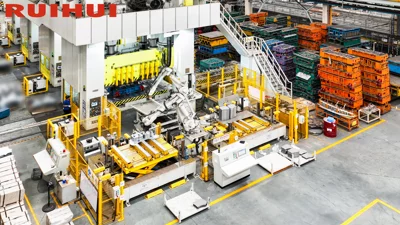
I've worked with a lot of products, from Ruihui's in-house solutions to real customer cases. Take small to medium-sized stamping lines: if they're split-type, they take up a huge amount of space and are complicated to tune. You need a separate area for uncoiling, another for leveling, and yet another for feeding. Moving coils around leads to scratches and misalignment—how can you maintain good yield that way? That's why we developed the integrated three-in-one feeding line to simplify the stamping process.
As for the different models of three-in-one leveling feeders, I used to think they were just three machines stacked together. But after joining Ruihui, I learned that's an oversimplification—they're fundamentally different. Speaking of Ruihui's capabilities in this field: we hold over 70 patents and have more than 80 engineers. Whatever your needs, our engineers will run multiple 3D simulations. Whether it's automotive parts, hardware components, or 3C sheet metal, our solutions cover most applications. We fully support customized solutions—just ask us anytime. Now, back to the topic.
The pain points of split-type lines:
- They take up too much space. After setting them up, there's barely room to walk. Want to reconfigure the line later? Good luck.
- Each unit must be adjusted individually. Changing a die takes half a day, with operators just waiting around.
- If one unit fails, you have to troubleshoot each one. One misfeed = one batch of scrap.
- Yield fluctuates unpredictably, which is a huge headache. When that happens, production efficiency suffers—and the root cause isn't slow workers. It's the scattered equipment. Material handling and alignment between units waste time and quality.
- After integration: One machine, from uncoiling to feeding. No more moving coils around. With servo control, secondary positioning errors are eliminated. Everything becomes consistent, and future line modifications are much more flexible. Many tedious steps are directly optimized.
Some might ask: with fewer steps, does the machine break down more easily? Here's the truth: Ruihui parts are CNC-finished with digital inspection, and our tolerances are extremely tight. ISO, CE—every machine is fully tested before leaving the factory. With thousands of global customers backing us—Honda, BMW, BYD are among them—we have a strong track record. We won't risk our reputation. So you can be completely confident in our after-sales support and quality. At the same time, we're actively building a global after-sales network, so overseas users can rest assured. You can also check our service center map on our website—feel free to take a look.
Simplification is fine, but the foundation must be solid; otherwise, it's just for show.
About after-sales: Many factories struggle with installing and debugging new equipment due to lack of professional engineering support. But as mentioned, Ruihui is working hard to achieve global after-sales coverage—we have local teams in Mexico, Europe, and Southeast Asia. Timely response is our most basic commitment. That includes on-site diagnosis, spare parts delivery, operator training, and hands-on guidance. You don't need to maintain a large in-house service team. When you calculate the total cost, isn't that a plus? Of course, as I said earlier, it depends on your location—not every region is covered yet. Please refer to the service map on our website.
Back to the three-in-one integrated vs. split-type. I used to think "3-in-1" just meant stacking them together. Now I know better. It's not just about saving floor space—it also eliminates the losses caused by intermediate handling and reduces labor intervention. That's a comprehensive improvement to your product profitability. In an earlier post, I included a concrete case study—feel free to check it out at the end. I'll share the link here: "Split-Type vs Integrated 3-in-1 Coil Feeding Lines- A Complete Comparison". Actually, the principle isn't complicated. But not many can truly deliver it.
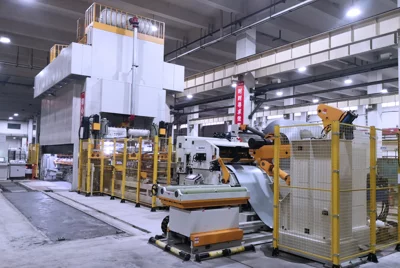
(Ruihui Automation MAC4 600 simple on-site test)
Thank you for reading all the way through. That's all for today's sharing. See you next time, and have a wonderful day!
Now that you've read to the end, would you like to calculate how much more profit you could generate by switching your existing line to an integrated three-in-one feeder, or by optimizing your current split-type line?
Contact RUIHUI right away, and our professional engineers will help you run the numbers.
With years of hands-on experience, I have honed my skills in navigating the complexities of global commerce, offering invaluable insights and solutions to address customer needs. My commitment to excellence and dedication to customer satisfaction ensure that I deliver exceptional service, guiding clients through every step of the trading process with confidence and proficiency.