

Split-Type vs Integrated 3-in-1 Coil Feeding Lines- A Complete Comparison
Share to : 


Today, let's talk about a common issue often encountered in the actual selection of stamping automation equipment:
Split-type vs integrated three-in-one feeding line – how to choose?
First, let me briefly introduce: In the stamping metal forming industry, split-type and integrated three-in-one feeding lines are core automation equipment. Both can perform uncoiling, leveling, and feeding, but their structural designs and applicable scenarios are indeed different. Ruihui has over 80 full-time engineers and more than 70 invention/utility model patents. Both types of feeding lines are self-developed, and the equipment has passed CE and ISO certifications, validated by thousands of customers worldwide.
Next, I will provide a comprehensive comparison from seven aspects, along with selection suggestions, and show you a real example to help everyone understand the differences.
1.Core structural differences
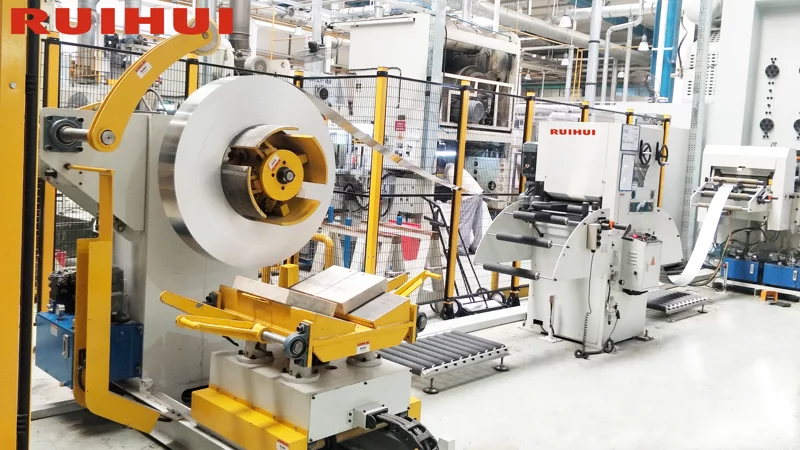
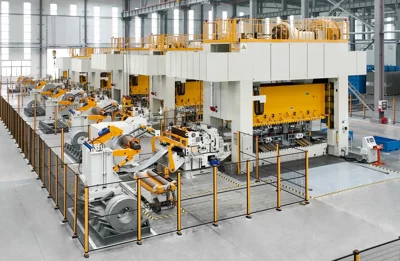
- Split type: The uncoiling, leveling, and feeding are separated into three independent units. Each module can be freely detached and arranged, offering high flexibility.
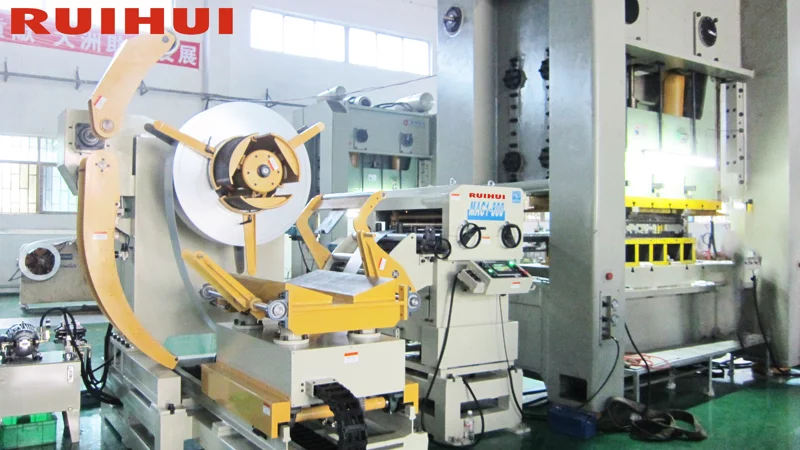
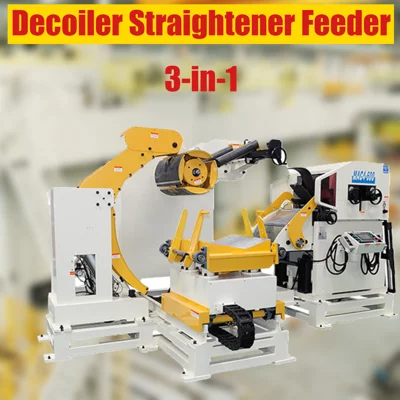
- Integrated type: The three major functions are integrated into a single main frame, forming a complete machine without separate structures.
- Common points: Both types of Ruihui equipment are manufactured using CNC precision machining and digital inspection, with unified manufacturing standards. Digital twin simulation technology is also used during the design phase to optimize performance, and customized solutions are available.
2. Space occupation, installation, and commissioning difficulty
- Split type: The layout is relatively scattered, requiring a material buffer zone between units, thus occupying a large overall footprint. During installation, each unit must be individually positioned and wired, and the debugging process for multiple modules in coordination is quite cumbersome, naturally leading to a longer production start-up cycle.
- Integrated type: The structure is highly compact, eliminating the need for an additional material storage area. According to calculations by our professional engineers, compared to the split type, it generally saves 30% to 50% of factory space (verified), and all these savings translate directly into tangible profits. The equipment can be installed and positioned in a single step upon arrival, with simple debugging steps, allowing mass production to begin quickly.
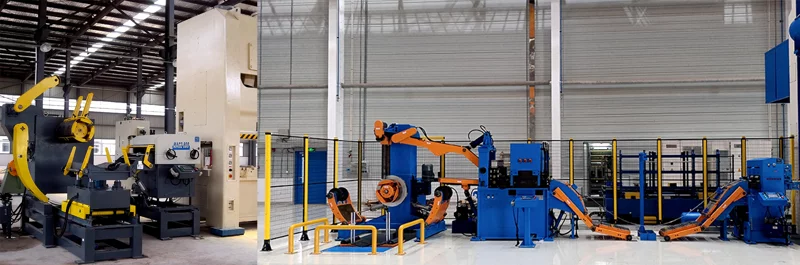
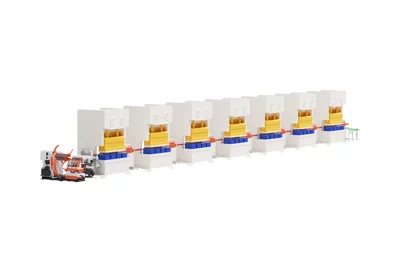
(Left: integrated three-in-one equipment; Right: split-type uncoiling, leveling, and feeding equipment)
3. Feeding accuracy and operational stability
- Split type: Independent units. Over long feeding distances, slight deviations can occasionally occur, and unit synchronization is only fair. Fully adequate for ordinary hardware stamping with standard accuracy requirements.
- Integrated type: Higher rigidity, precisely coordinated drive system, and zero backlash during strip transfer. The frame was optimized using FEA during design to minimize vibration at high speeds, resulting in higher feeding accuracy – ideal for high-precision stamping applications.
(Videos: MAC4-H Series machine)
4. Suitable production scenarios
Split type
- It is more suitable for wide, thick sheet coils and large stamping production lines, especially in scenarios requiring flexible coordination among multiple presses. Because each unit is independent, the layout can be flexibly adjusted according to different workpieces, offering advantages for custom production of large workpieces, small batches, and multiple varieties.
Integrated type
- Its application range is actually very wide. Of course, it is commonly used with small and medium presses, but large stamping lines can also be equipped with the integrated type – for example, in mass production of automotive parts, home appliance panels, etc. The integrated type is actually more popular because of its high feeding accuracy, fast material changeover, and small footprint. In short: as long as your coil specifications are relatively fixed and you pursue efficiency and precision, regardless of press size, the integrated type is worth considering.
To add: Ruihui's integrated three-in-one feeding lines come in multiple models and specifications, covering narrow materials from 50~1000mm (MAC3 NC Straightener Feeder) up to 2.0~12mm plate thickness (MAC6-H NC Straightener Feeder), so large press integration is not an issue at all.
Ruihui's equipment has served well-known companies such as Honda, BMW, and BYD, and has also been exported to Europe, Southeast Asia, Mexico, and other regions.
5. Maintenance cost and service life
- Split type
- The advantage is that the modules are independent; if a component fails, it can be removed and repaired separately, offering flexible maintenance. However, because the equipment is scattered across multiple points, the daily inspection and routine maintenance workload is greater.
- Integrated type
- Components are concentrated and integrated, with fewer maintenance points, making daily operation and maintenance easier. However, when core components need repair, the entire machine must be inspected. Fortunately, the equipment undergoes full-process quality inspection before delivery, resulting in stronger overall durability and a more stable service life.
6. Core parameter comparison table
| Comparison Dimension | Split-Type Three-in-One Feeding Line | Integrated Three-in-One Feeding Line |
| Structure | Modular, separate units | Fully integrated machine |
| Floor space | Large, requires buffer zone | Small, saves factory space |
| Installation & commissioning | Complex process, longer lead time | Quick installation, easy commissioning |
| Feeding accuracy | Standard accuracy | High accuracy, deviation controllable |
| Suitable applications | Thick, wide coils; custom production | Standard coils; high-volume mass production |
| Initial investment | Lower purchase cost | Higher initial investment due to integration |
7. How to choose
- Split type: Ideal if you have ample space, need to process wide/thick coils, and want a flexible layout.
- Integrated type: Best if space is limited, you focus on standardized mass production, and need quick startup.
Ruihui offers customized solutions with a professional after-sales team. Global service points can quickly provide troubleshooting, spare parts supply, and operation training.
8. Real case
(In this era where efficiency reigns supreme, a treasure device that’s worth three in one has arrived )
An automotive parts supplier in South China previously used a split-type three-in-one feeding line. They struggled with long cycle times, and each coil change took significant time due to parameter adjustments for leveling and feeding. After switching to Ruihui's integrated three-in-one feeding line, coil change time dropped sharply, and overall line efficiency improved significantly compared to the split type. More importantly, the integrated type's higher feeding accuracy substantially lowered the defect rate. The owner ran the numbers and found that the price premium over the split type was typically recouped within six months to a year—everything after that was pure profit.
After reading this, would you like to calculate how much profit your existing production line could generate by switching to an integrated three-in-one feeding line, or by optimizing your current split-type system?
Then contact RUIHUI immediately, and our professional engineers will help you calculate directly.
RUIHUI – Making metal forming easier.
With years of hands-on experience, I have honed my skills in navigating the complexities of global commerce, offering invaluable insights and solutions to address customer needs. My commitment to excellence and dedication to customer satisfaction ensure that I deliver exceptional service, guiding clients through every step of the trading process with confidence and proficiency.
You may also like
Related News

Latest Update