

Hot Forming Loading Unloading Robot How to Select the Right Payload Capacity
Share to : 


Hot stamping forming differs significantly from conventional cold stamping, and one critical aspect is robot selection—particularly payload capacity. In high-temperature environments, many conventional rules of thumb may no longer apply. If the wrong model is chosen, the consequences can range from compromised cycle times to equipment failure. So, under hot forming conditions, how exactly should you evaluate and select the robot's payload?
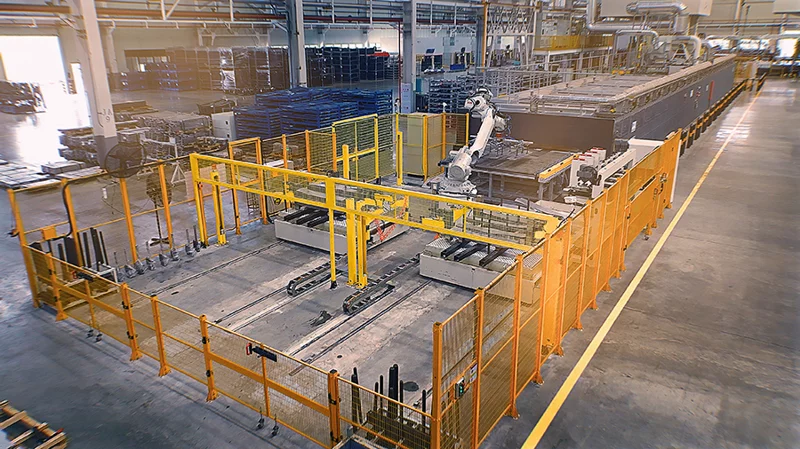
First, it's important to understand that hot formed parts are not lightweight. Hot stamping is primarily used to produce automotive safety structural components—such as A-pillars, B-pillars, and anti-intrusion beams. To ensure strength, these parts typically use thicker boron steel sheets. While the parts themselves may not appear very large, when you add the weight of the gripper tooling, the total load is actually far from negligible.
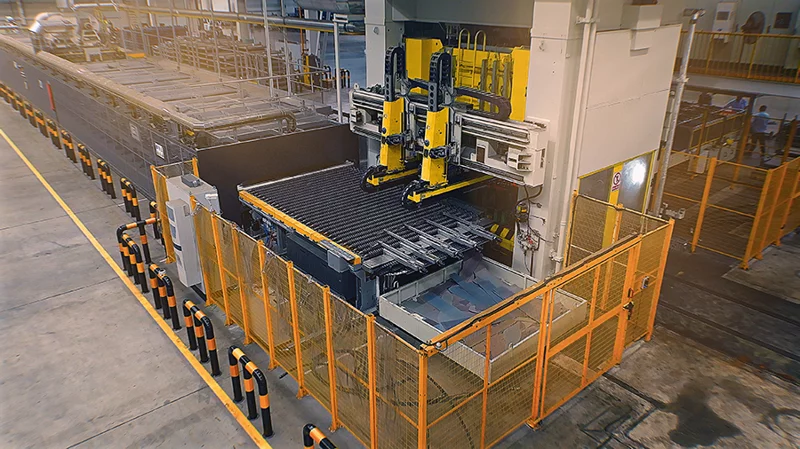
Second—and most importantly—you must account for "dynamic load." When a robot moves at high speed—especially during acceleration, deceleration, and directional changes—it generates significant inertial forces. These forces are superimposed on the static weight, creating impact loads on the robot's joints and arms. In cold stamping, this factor also needs consideration, but in hot stamping, where cycle time demands are even higher and robots move faster, the effect of inertial forces is even more pronounced. Therefore, when selecting a model, you must never look only at the static total weight of the workpiece and gripper—you must leave sufficient margin.
A prudent approach is to calculate the total weight of the workpiece plus gripper, and then select a robot with a rated payload that includes at least 30% to 50%—or even more—safety margin. For example, if the workpiece plus gripper weighs 20 kg, it's best to choose a model with a rated payload of 30 kg or above. This ensures that the robot remains stable even at high speeds, without vibration affecting positioning accuracy or risking dropping the part.
Additionally, the design of the end-effector—the gripper—must be considered. Grippers for hot formed parts need to be heat-resistant and typically use special materials and thermal insulation designs, which adds to their weight. When calculating the total load, this weight must be accurately accounted for and not just estimated by feel.
There is also a unique factor in hot forming—high temperatures cause uneven temperature distribution in the workpiece, which may lead to slight thermal deformation during transfer. Although the deformation is minimal, for parts with high precision requirements, the force control during gripping and placement needs to be adjusted accordingly. This places higher demands on the force control accuracy of the servo drive system.
Furthermore, the extreme temperature of the part emerging from the furnace means that thermal expansion also affects gripping stability. The gripper design must account for dimensional changes caused by thermal expansion, ensuring that the part does not slip or get crushed during high-temperature gripping. These details all affect actual load performance, so selection cannot rely solely on nameplate specifications.
When providing hot forming automation solutions for automotive safety part customers, Guangdong RuiHui Intelligent Technology Co., Ltd. applies very stringent standards to robot payload selection. RuiHui's engineers perform detailed dynamic simulations and calculations based on the customer's specific products, cycle time requirements, and gripper design, ensuring that the selected robot can not only "lift the load" but also "run steadily"—maintaining high precision and reliability over long-term high-speed operation.
In summary, the core principle of payload selection for hot forming robots is to fully account for dynamic inertial forces and reserve ample safety margin. When in doubt, go bigger—this is the key principle for ensuring long-term stable operation of the production line.
With years of hands-on experience, I have honed my skills in navigating the complexities of global commerce, offering invaluable insights and solutions to address customer needs. My commitment to excellence and dedication to customer satisfaction ensure that I deliver exceptional service, guiding clients through every step of the trading process with confidence and proficiency.
You may also like
Related News
Latest Update