

Hot‑Stamped Parts High‑Strength Light‑Weight Advantage Analysis for Automotive Safety‑Component Applications
Share to : 


Automotive safety components such as A‑pillars, B‑pillars, bumper beams and sill beams serve as critical structures for passenger‑cabin protection. They demand high impact resistance and lightweight properties to reduce vehicle weight and fuel consumption. Hot‑stamped parts satisfy both requirements and gain expanding adoption in automotive safety‑part manufacturing.
Conventional cold‑stamped high‑strength steel reaches 500‑600 MPa. After heating, stamping and in‑die quenching, hot‑stamped steel transforms into martensitic microstructure with strength above 1500 MPa, two to three times that of ordinary high‑strength steel. Higher strength enables thinner‑wall design and weight reduction under equivalent load conditions.
Major application advantages are as follows. First, superior crash‑safety performance. High‑strength hot‑stamped components resist excessive deformation during collisions and preserve passenger‑cabin integrity for A‑pillars, B‑pillars, bumper and sill beams. Second, remarkable lightweight effect: every 10 % vehicle‑weight reduction cuts fuel consumption by 6‑8 %. Cumulative weight saving is significant when multiple safety‑related parts adopt hot stamping, which is especially valuable for new‑energy vehicles to improve driving range. Third, excellent formability. High‑strength steel tends to crack during cold forming. Heated to approximately 900 °C, the material acquires high plasticity for one‑shot forming of complex geometries and fewer tooling sets. In‑die quenching delivers low springback and high dimensional accuracy.
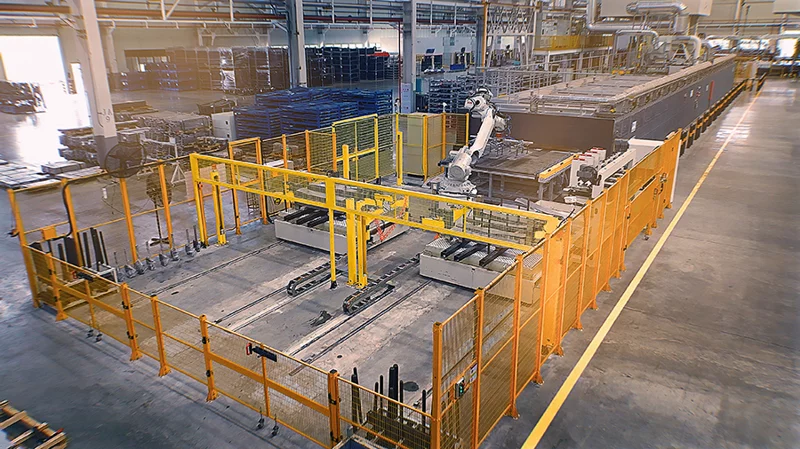
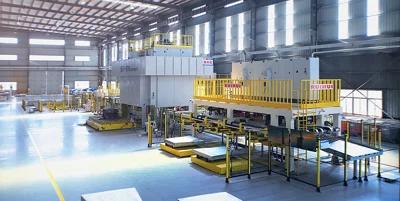
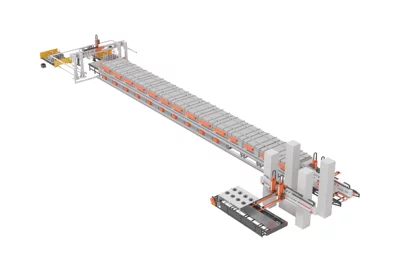
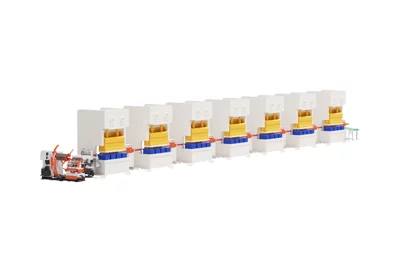
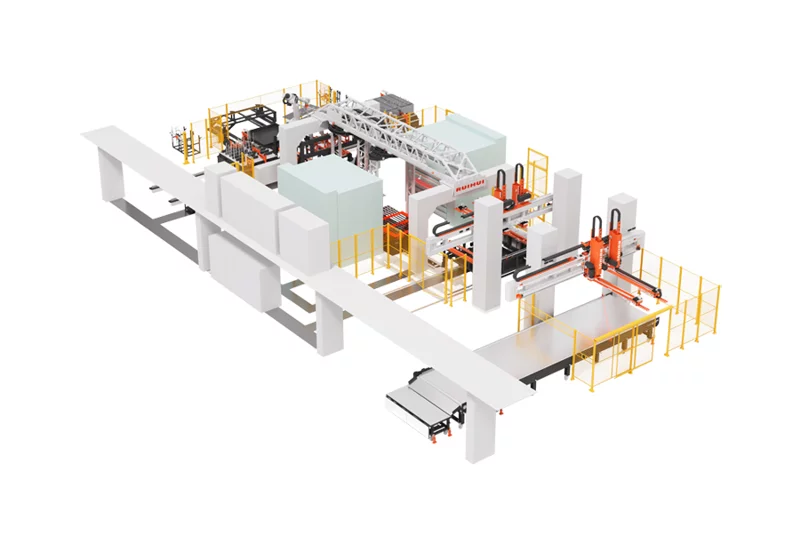
Hot‑stamping production relies on hot‑forming lines consisting of heating furnaces, loading‑unloading manipulators, high‑tonnage presses, die‑cooling systems and control units. Blanks are heated to around 900 °C. Manipulators transfer red‑hot blanks into press dies for forming and rapid quenching. The interval from furnace exit to die entry must be limited to several seconds to minimize heat loss.
Heat‑resistant alloy steel grippers instead of vacuum suckers are adopted as manipulator end‑effectors. Rubber‑based suction cups would melt under high temperature, while alloy‑steel grippers maintain stable clamping force under thermal conditions. Manual operation is infeasible due to extreme blank temperature and strict transfer‑time constraints. Automated handling guarantees consistent transfer speed and stable product quality, meanwhile keeping operators away from high‑temperature and stamping hazards.
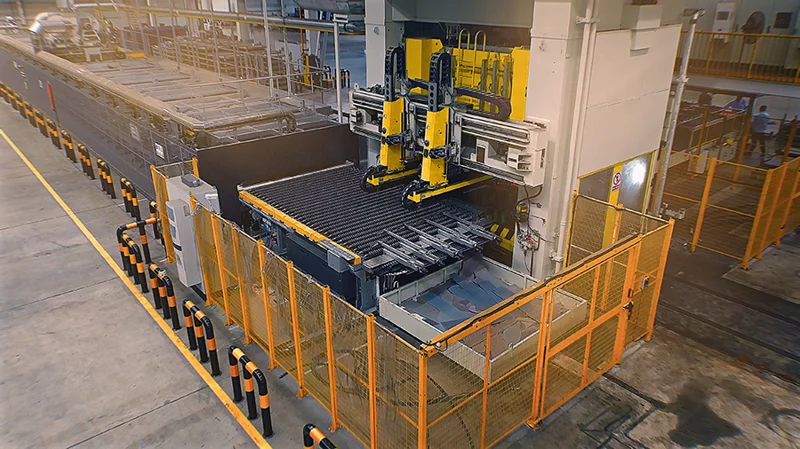
Guangdong Ruihui Intelligent Technology Co., Ltd. has over 20‑year experience in stamping automation and is a national Specialized, Refined, Differential and Innovative “Little Giant” enterprise. Headquartered in Dongguan, it has more than 400 employees including over 80 R&D engineers. Ruihui delivers proven hot‑forming automation solutions covering furnace in‑out manipulators, press loading‑unloading robots and full‑line control integration. Heat‑resistant alloy‑steel grippers are deployed for hot‑blank handling, with abundant practical references for automotive hot‑formed components. Nearly 5,000 sets of Ruihui‑manufactured equipment run at domestic and overseas customer sites, serving well‑known OEMs and Tier‑one suppliers such as BYD, Geely, Volkswagen, Tesla, BMW, Mercedes‑Benz, Honda and Jaguar Land Rover.
With years of hands-on experience, I have honed my skills in navigating the complexities of global commerce, offering invaluable insights and solutions to address customer needs. My commitment to excellence and dedication to customer satisfaction ensure that I deliver exceptional service, guiding clients through every step of the trading process with confidence and proficiency.
You may also like
Related News
Latest Update