

What Are the Requirements for Slitting New Energy Battery Materials on a Slitting Line
Share to : 


The requirements for slitting materials used in new energy batteries are significantly higher than those for ordinary steel. Nickel-plated steel strip and aluminum strip for battery enclosures, copper foil and aluminum foil for battery tabs, and high-strength steel and aluminum alloy for battery pack structural components—after slitting, these materials go directly into battery production lines. Any burr, width deviation, or surface scratch can affect the sealing performance, conductivity, and safety of the battery.
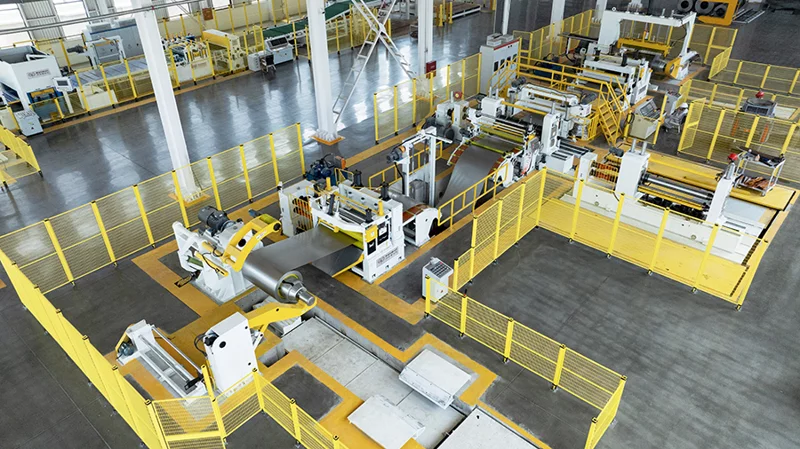
First, let's discuss the requirements arising from material characteristics. For nickel-plated steel strip used in battery enclosures, the nickel layer on the surface provides corrosion resistance and conductivity. During slitting, if the blades are not sharp enough, the nickel layer at the cut edge will be torn, exposing the steel substrate underneath and reducing corrosion resistance. Therefore, the circular slitter blades on the slitting line must be made of high-hardness, high-wear-resistant materials, and the cutting edges must remain sharp, producing clean edges with an intact nickel layer. Copper foil and aluminum foil are even thinner—some only a few micrometers thick. During slitting, tension control must be extremely precise. If tension is too high, the foil may break or wrinkle; if tension is too low, the rewound coil will be loose with uneven end faces.
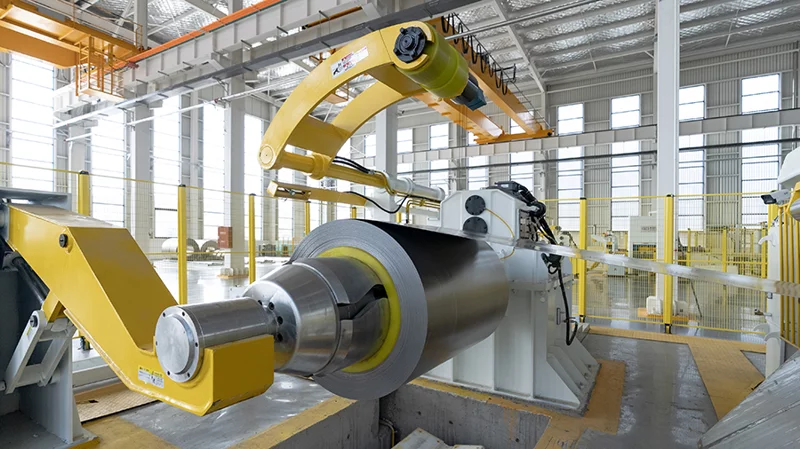
The precision requirements for slit width are also very strict. The width tolerance for battery tab slitting is generally required to be within ±0.05 mm, which is twice as tight as the ±0.1 mm tolerance for ordinary steel slitting. Such high precision relies on high-precision servo feeding, high-rigidity arbors, and high-resolution encoders working together. Blade mounting precision must also be high. When several blades are mounted on the same arbor, their parallelism and spacing must be controlled to the micrometer level; otherwise, the slit narrow strips will have inconsistent widths.
Burr control is the top priority in battery material slitting. If the burrs on copper foil and aluminum foil exceed the allowable value, they may pierce the separator during battery winding, causing internal short circuits. The blade clearance of the slitting line must be precisely set for different materials. The clearance for copper foil and aluminum foil is completely different from that for steel strip. Better slitting lines now feature automatic clearance adjustment systems: input the material thickness and type, and the system automatically calculates the optimal clearance, reducing the uncertainty of manual clearance adjustment. The grinding quality of the blade edges also directly affects burr size. Regular inspection and replacement of blades are necessary measures to ensure stable burr control.
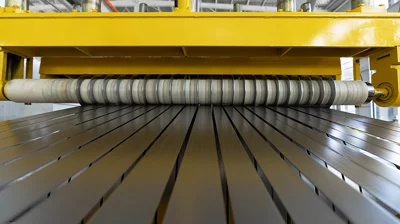
Surface protection is equally important in battery material slitting. The surfaces of copper foil and aluminum foil must not have scratches, pressure marks, or oxidation discoloration. The guide rollers, tension rollers, and rewinding mandrels on the slitting line—all parts that contact the material—must have smooth surfaces, free of rust and burrs. Some slitting lines wrap the guide rollers with a layer of soft material to prevent direct metal contact from scratching the foil. Dust and debris generated during slitting must be cleaned up promptly and must not fall onto the strip.
Rewinding quality is also critical for battery material slitting. After rewinding, copper foil and aluminum foil are sent to the battery winding process. The tightness of the coil and the neatness of the end faces directly affect the smoothness of subsequent unwinding. The rewinding mechanism of the slitting line must be equipped with servo tension control, with each narrow strip's tension individually adjustable, producing coils with consistent tightness and flat end faces.
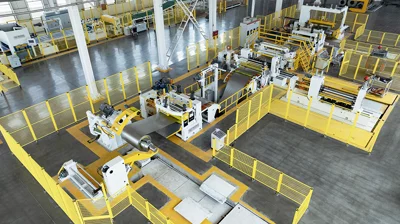
In new energy battery material slitting scenarios, the greatest value of replacing manual labor with automation lies in quality consistency. Manual participation in slitting, rewinding, and handling—hand contact with the material, moisture from breathing, and operational instability—all affect product quality. After the slitting line is automated, the material goes from decoiling to slitting to rewinding without touching the ground or human hands, resulting in much more stable surface quality and dimensional accuracy. At the same time, copper foil and aluminum foil are thin and sharp, and manual handling easily cuts hands. After automation, workers are kept away from these hazardous steps.
Guangdong RuiHui Intelligent Technology Co., Ltd. has been deeply engaged in the field of stamping automation for over twenty years. It is a national "Specialized and Sophisticated" "Little Giant" enterprise, headquartered in Dongguan, with more than 400 employees and over 80 R&D personnel. In the field of slitting lines, RuiHui offers configuration solutions specifically for new energy battery materials, with targeted designs in blade materials, clearance control, tension systems, and surface protection, meeting the slitting precision requirements for battery enclosure materials, tab foils, and other applications. RuiHui has nearly 5,000 sets of equipment operating at customer sites both domestically and internationally, serving well-known OEMs and first-tier suppliers such as BYD, Geely, Volkswagen, Tesla, BMW, Mercedes-Benz, Honda, and Land Rover Jaguar.
With years of hands-on experience, I have honed my skills in navigating the complexities of global commerce, offering invaluable insights and solutions to address customer needs. My commitment to excellence and dedication to customer satisfaction ensure that I deliver exceptional service, guiding clients through every step of the trading process with confidence and proficiency.
Related Topics:
slitting lineYou may also like
Related News
Latest Update