

What Is the Principle of Hot Stamping How Is High-Strength Steel Lightweighting Achieved
Share to : 


The principle of hot stamping can be summarized in one sentence: heat high-strength steel to soften it, stamp it into shape, and then rapidly cool it to harden it. This process leverages the phase transformation characteristics of steel at high temperatures, combining the advantages of "good plasticity for forming" and "quenching to high strength," solving the problem that high-strength steel is difficult to stamp at room temperature.
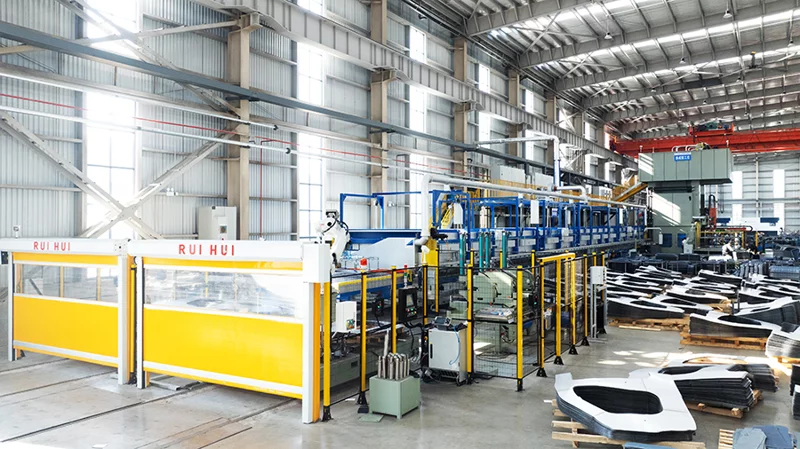
Specifically, hot stamping utilizes a materials science characteristic of steel: the transformation from austenite to martensite. At room temperature, the microstructure of high-strength steel consists of ferrite and pearlite, which has high hardness but poor plasticity and is prone to cracking during stamping. However, when heated to above 900°C, the microstructure transforms into austenite. Austenite has good plasticity and low deformation resistance, allowing it to be formed as easily as ordinary mild steel. After forming, rapid cooling (quenching) transforms the austenite into martensite. Martensite has extremely high hardness, with strength reaching over 1,500 MPa.
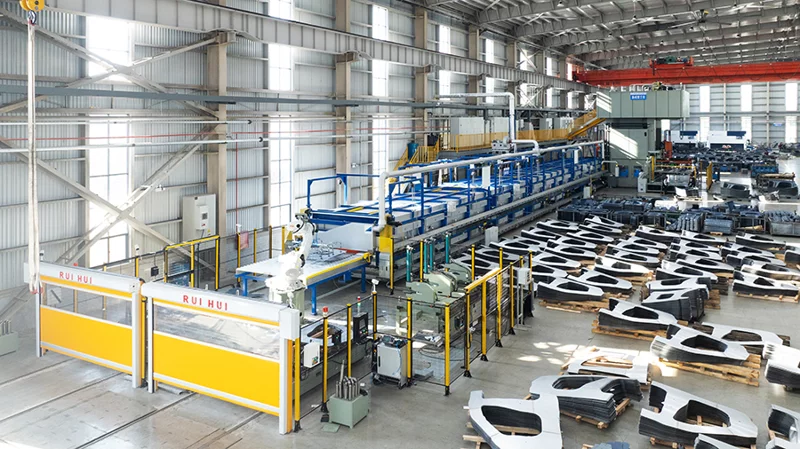
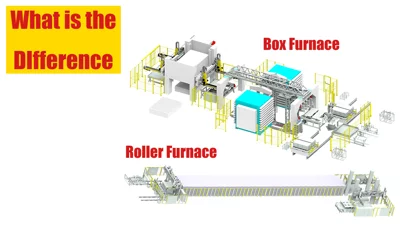
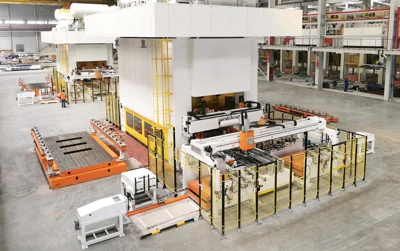
The three stages of "heating to soften, forming, and quenching to harden" are implemented on a hot stamping line as follows: the blank first enters a heating furnace and is heated for 3 to 6 minutes until it reaches approximately 930°C, completing austenitization. A robot then rapidly transfers the red-hot blank into the press die. Dense cooling channels are arranged inside the die, and quenching begins immediately after the die closes and forms the part. The cooling rate is critical—it must reach 30 to 50°C per second to fully achieve the martensite transformation. If the cooling rate is insufficient, the martensite transformation will be incomplete, and the part strength will not meet design requirements. The entire quenching process lasts from several seconds to more than ten seconds inside the die, until the part temperature drops below 200°C, after which the die opens and the part is removed.
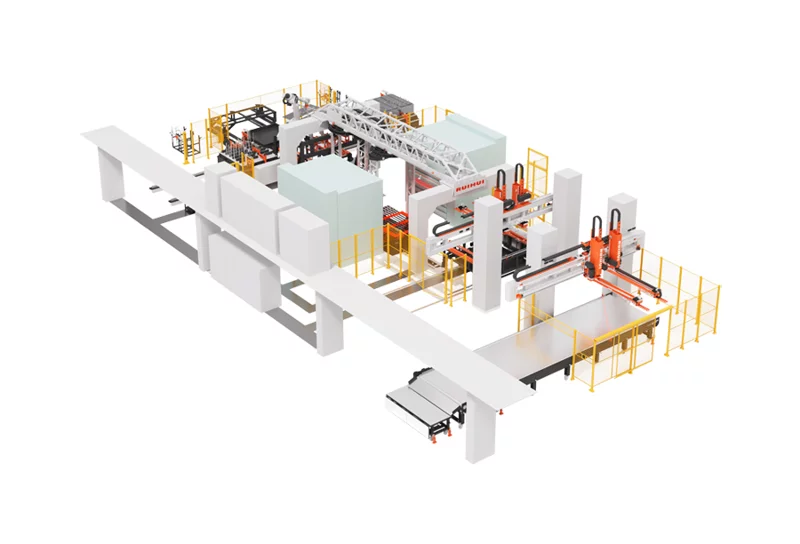
So how is "lightweighting" achieved? The principle is simple: higher strength means thinner material can be used. To achieve the same strength with traditional cold-stamped parts, thicker sheet metal is required, making the part heavier. Hot-stamped parts with 1,500 MPa strength are approximately three to five times stronger than ordinary high-strength steel. If a part's strength is three times that of ordinary steel, then under the same load-bearing conditions, the thickness of a hot-stamped part can be about one-third that of an ordinary steel part. For example, a part that originally required 2 mm thickness may need only 1.2 mm or even 1 mm with hot stamping, immediately reducing weight.
Take an automotive B-pillar as an example. A traditional cold stamping solution using ordinary high-strength steel might require 1.8 mm thickness to ensure crash strength. Switching to hot stamping, 1.2 mm is sufficient—reducing the weight of a single part by one-third. The B-pillar is a relatively heavy structural component in the vehicle body, and this high weight reduction ratio contributes significantly to overall vehicle lightweighting. After lightweighting, fuel or electricity consumption decreases and driving range increases—this is why new energy vehicles and energy-efficient vehicles are increasingly adopting hot-stamped parts.
However, hot stamping also has its limitations. First, equipment investment is relatively high—the heating furnace, large-tonnage press, high-temperature-resistant robots, and die cooling system mean the entire production line requires considerably more investment than cold stamping. Second, process control requirements are strict—if the temperature is too high or too low, the transfer is too fast or too slow, or the cooling is too fast or too slow, the final part performance will be affected. Third, product shapes cannot be too complex—overly complex shapes tend to deform during quenching due to uneven thermal stress distribution. Therefore, hot-stamped parts are currently mainly used for relatively regular structural components such as automotive crash beams, A-pillars, B-pillars, and door reinforcement panels.
Hot stamping solves two problems: "high-strength steel cannot be stamped" and "automotive vehicles are too heavy." It is an important technological path for achieving automotive lightweighting. Although the process requirements are demanding and the equipment investment is large, for vehicles pursuing safety and energy efficiency, it is a technology worth investing in.
Guangdong RuiHui Intelligent Technology Co., Ltd. has been deeply engaged in the field of stamping automation for over twenty years. It is a national "Specialized and Sophisticated" "Little Giant" enterprise, headquartered in Dongguan, with more than 400 employees and over 80 R&D personnel. In the field of hot stamping, RuiHui provides heating furnace loading/unloading robots, press loading/unloading robots, and complete line control systems. Its high-temperature-resistant robots use heat-resistant alloy steel to ensure structural rigidity and operational stability under high temperatures, with mature applications in the production of automotive hot-stamped parts. RuiHui has nearly 5,000 sets of equipment operating at customer sites both domestically and internationally, serving well-known OEMs and first-tier suppliers such as BYD, Geely, Volkswagen, Tesla, BMW, Mercedes-Benz, Honda, and Land Rover Jaguar.
With years of hands-on experience, I have honed my skills in navigating the complexities of global commerce, offering invaluable insights and solutions to address customer needs. My commitment to excellence and dedication to customer satisfaction ensure that I deliver exceptional service, guiding clients through every step of the trading process with confidence and proficiency.
You may also like
Related News
Latest Update