

Why Hot Stamping Lines Must Be Automated Why Manual High-Temperature Loading and Unloading Is Impossible
Share to : 


Hot stamping is an important process for producing high-strength steel parts: the blank is heated to around 800–900°C, stamped while hot, and rapidly cooled and quenched inside the die. The resulting parts are strong and lightweight. This process is highly effective, but there is a practical problem: high-temperature loading and unloading simply cannot be done manually. Why must a hot stamping line be automated? The answer can be found in the characteristics of the hot stamping process itself.
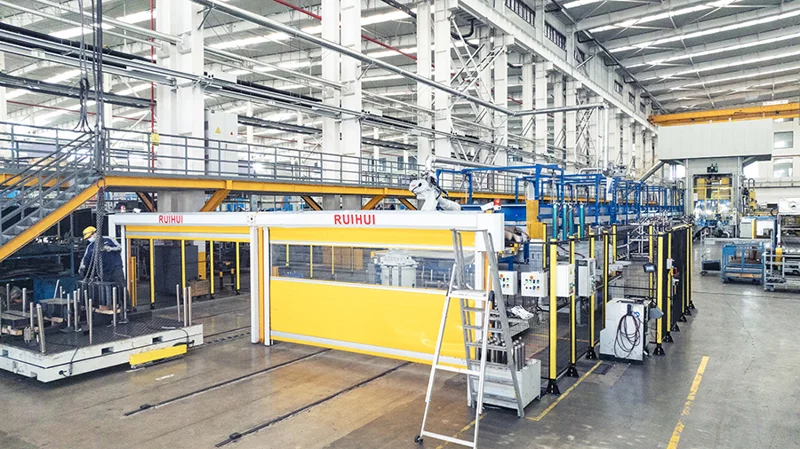
First, consider the temperature. Hot stamping blanks must be heated to around 800–900°C to reach the austenitizing temperature. What does 800–900°C mean? At this temperature, humans simply cannot get close—let alone reach out and pick up the blank. Even standing nearby is unbearable. The very first step of manual loading and unloading is impossible—once the red-hot blank exits the heating furnace, a person cannot even touch it.
Next, consider time. Hot stamping has extremely strict time requirements. After the blank is removed from the furnace, its temperature drops rapidly. It must be fed into the die within a certain time window. If it is too late, the temperature will be insufficient, the microstructure transformation will be incomplete, the quenching effect will be poor, and the part strength will not meet requirements. This time window is very short. Manual operation simply cannot keep up. The process from picking the blank at the furnace outlet to placing it into the die must be completed quickly and accurately by equipment.
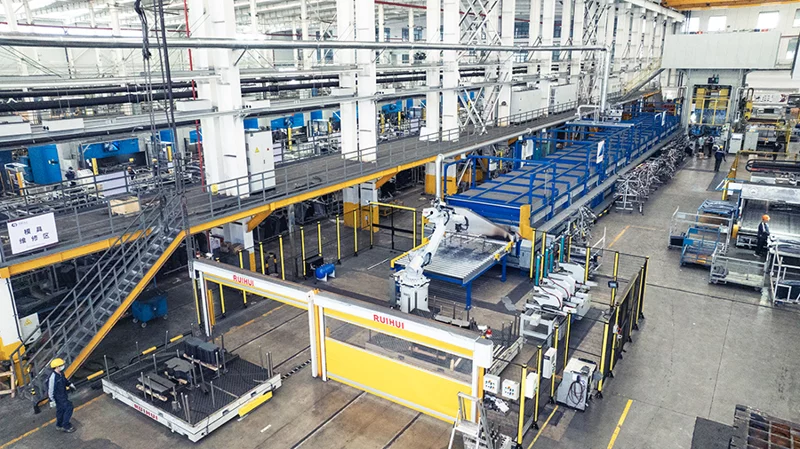
Next, consider accuracy. The blank must be placed into the die in exactly the right position. If it is off-center, the stamped part will be unacceptable. In a high-temperature environment, workers are rushed and flustered, and cannot possibly guarantee placement accuracy. A robot picks and places with precise, repeatable positions every time, ensuring product consistency.
Next, consider continuity. Hot stamping is mass production. Blanks enter the furnace, exit the furnace, and are stamped one after another. If manual labor cannot handle the high-temperature steps, the entire line breaks down, and production continuity cannot be guaranteed. Automated equipment can run continuously, producing batch after batch, ensuring capacity.
Therefore, a hot stamping line must be automated. This is not a question of efficiency or cost—it is a question of whether production is possible at all. The high-temperature loading and unloading step is physically impossible for humans; it can only be handled by automated equipment. This is determined by the hot stamping process itself. Without automation, hot stamping cannot achieve mass production.
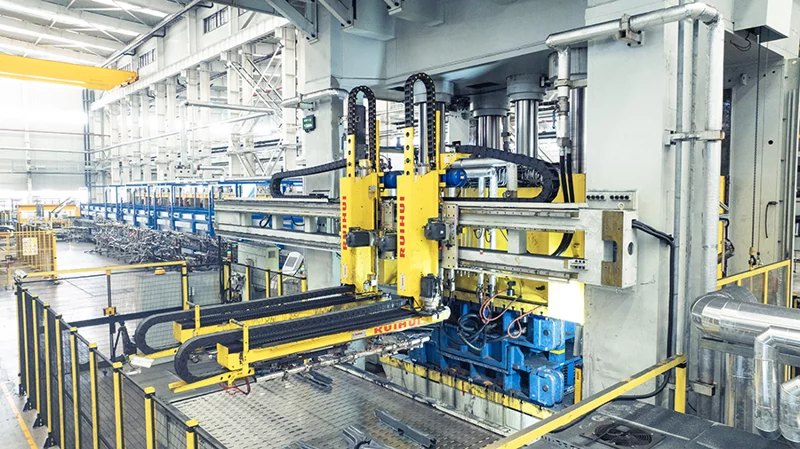
So how does automated equipment cope with high temperatures? The key lies in the equipment's high-temperature resistance. The hot stamping loading and unloading robot must directly contact blanks at 800–900°C—especially during loading, when it grips the red-hot blank from the furnace outlet. The end effector must withstand this temperature. What makes this possible? Mainly the high-temperature resistance of the end effector material. Hot stamping robot end effectors are essentially always grippers made from high-temperature alloy materials that can withstand the heat of the hot blank for extended periods without deforming or failing. Suction cups rely on vacuum; rubber and plastic cups cannot endure 800–900°C. Therefore, hot stamping robot end effectors are essentially always grippers, and high-temperature resistance depends mainly on the end effector material itself.
In addition to the end effector's high-temperature resistance, the hot stamping robot must also work near a high-temperature environment for extended periods. Its drive system and control system must be designed with thermal insulation and heat dissipation to ensure stable continuous operation. The control of the entire line must also be precise—when the heating furnace discharges, when the robot picks up the part, and when the press stamps must all be accurately coordinated in timing for the entire line to run efficiently. The hot stamping line must be automated—this is a hard requirement of the process and a prerequisite for safety.
Guangdong RuiHui Intelligent Technology Co., Ltd. has been deeply engaged in the field of stamping automation for over twenty years. It is a national "Specialized and Sophisticated" "Little Giant" enterprise, headquartered in Dongguan, with more than 400 employees and over 80 R&D personnel. RuiHui has specialized technical expertise in hot stamping automation. For the high-temperature conditions of high-strength steel hot stamping, it has developed high-temperature-resistant loading and unloading robots. The end effectors use high-temperature alloy grippers and can operate stably for long periods in high-temperature environments. Combined with heating furnaces, presses, and front/back-end conveying equipment, RuiHui provides complete hot stamping line automation solutions. RuiHui has supplied hot stamping automation lines to numerous automotive parts manufacturers. With nearly 5,000 sets of equipment operating at customer sites both domestically and internationally, serving well-known OEMs and first-tier suppliers such as BYD, Geely, Volkswagen, Tesla, BMW, Mercedes-Benz, Honda, and Land Rover Jaguar, RuiHui has rich experience in the hot stamping field.
With years of hands-on experience, I have honed my skills in navigating the complexities of global commerce, offering invaluable insights and solutions to address customer needs. My commitment to excellence and dedication to customer satisfaction ensure that I deliver exceptional service, guiding clients through every step of the trading process with confidence and proficiency.
Related Topics:
hot stamping formingYou may also like
Related News
Latest Update