

How Much Can a Laser Blanking Line Improve Material Utilization
Share to : 


For bosses investing in a laser blanking line, the biggest concern is: how much material can it actually save? After all, a laser blanking line costs significantly more than traditional stamping blanking. If material savings are not obvious, the investment is not worthwhile. There is no standard answer, because how much material utilization can improve depends on product shape, nesting method, and the baseline of the traditional process being compared. But we can analyze from several angles to give you a rough idea.
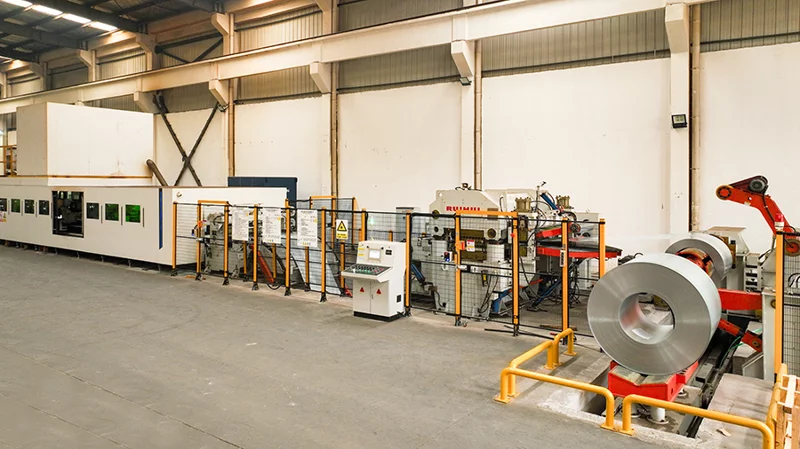
First, clarify a concept: what is material utilization? It is "finished product weight ÷ actual material weight consumed × 100%." In traditional stamping blanking, products are punched out of sheet metal with dies. The spacing between products (the web allowance) cannot be too small, otherwise the die strength is insufficient or the strip may break during stamping. Moreover, the die is fixed, so the product layout is basically fixed and difficult to adjust flexibly.
Here is where the laser blanking line shines. First, no-web cutting. Laser cutting does not require the web allowance needed in stamping. Products can be placed very close together or even share a common edge, which alone can save several percentage points of material. Second, flexible nesting. Software can mix different shapes on the same sheet—inserting small parts beside large ones to fill in the corners and edges, something die stamping simply cannot do. Third, product shape optimization. Laser blanking can cut any shape. Traditional stamping blanking sometimes compromises product shape to balance die strength and process requirements. Laser blanking does not—the product is cut exactly as designed, fully matching the design dimensions.
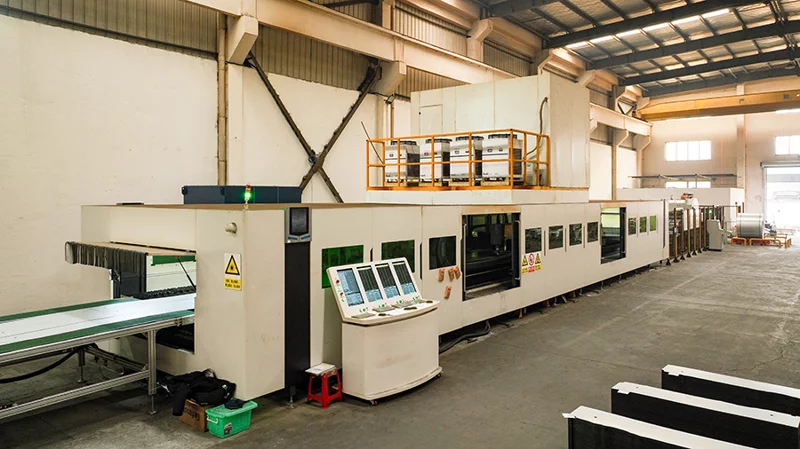
So how much can actually be saved? Let's look at several typical scenarios. For automotive chassis structural parts, many are irregularly shaped. Traditional stamping blanking uses rectangular blanks followed by subsequent processing, and material utilization may be less than 70%. Switching to a laser blanking line, which cuts the finished shape directly, combined with nesting software for common-edge cutting and mixed nesting, can raise utilization above 85%—an improvement of more than ten percentage points. For home appliance panel products, which have relatively regular shapes, traditional utilization is already not low, perhaps just over 80%; laser blanking can raise it to around 90%, an improvement of five or six points. For round or elliptical products, the "interlocking nesting" advantage of a laser blanking line is even more obvious. Through staggered arrangement, edge scrap is greatly reduced, and utilization can be 20 percentage points higher than traditional methods.
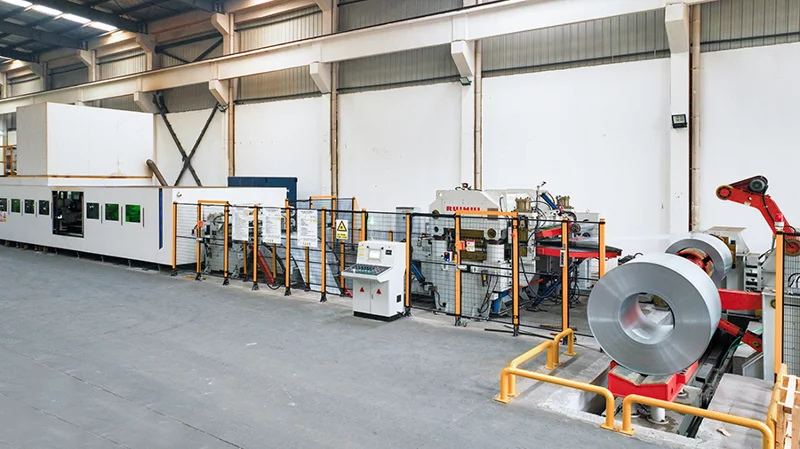
These numbers may not look large, but when converted to money, they become very tangible. Suppose you use 1,000 tons of steel per year. If utilization rises from 70% to 85%, it means that instead of buying 1,428 tons of material to produce 1,000 tons of finished product, you only need 1,176 tons—buying 252 fewer tons of material per year. At several thousand yuan per ton, the material cost savings are considerable, and the equipment investment can be recovered in no time.
Beyond saving material, laser blanking lines offer another indirect utilization benefit: reducing edge scrap and head/tail waste. On traditional cut-to-length lines or stamping lines, there is always a section of strip at the beginning and end of a coil that cannot be used because the shape is incomplete or the dimensions are insufficient. A laser blanking line can use software optimization to make use of this section as well. Although the absolute savings per instance are not large, accumulated over time it is still material saved.
Of course, material utilization is also directly related to the level of the nesting software. Good software algorithms can find the optimal layout; poor software may arrange parts loosely and actually waste more. When selecting a laser blanking line, be sure to ask the manufacturer to run several actual nesting examples using your own products. Do not just listen to promotional claims that "it saves a lot"—look at the specific numbers.
Overall, the improvement in material utilization from a laser blanking line is real and tangible, especially for production scenarios with many irregular parts and diverse product dimensions. No dies required, no web allowance, flexible mixed nesting, and full use of edge scrap—these are the concrete material-saving advantages of laser blanking lines.
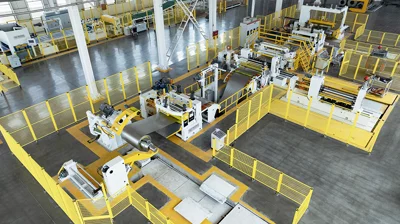
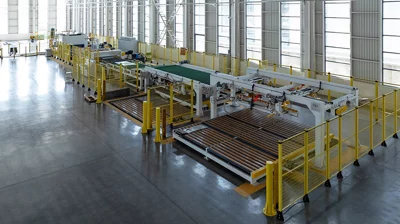
Guangdong RuiHui Intelligent Technology Co., Ltd. has been deeply engaged in the field of stamping automation for over twenty years. It is a national "Specialized and Sophisticated" "Little Giant" enterprise, headquartered in Dongguan, with more than 400 employees and over 80 R&D personnel. RuiHui's laser blanking lines are equipped with a mature automatic nesting system that supports common-edge cutting and flexible nesting. Combined with servo feeding to ensure cutting position accuracy, they provide complete line integration from decoiling, leveling, and feeding to cutting, sorting, and stacking, helping customers improve material utilization and reduce scrap losses. RuiHui has laser blanking line applications in the automotive parts, hardware components, and other industries. With nearly 5,000 sets of equipment operating at customer sites both domestically and internationally, serving well-known OEMs and first-tier suppliers such as BYD, Geely, Volkswagen, Tesla, BMW, Mercedes-Benz, Honda, and Land Rover Jaguar, RuiHui has rich experience in material utilization optimization.
With years of hands-on experience, I have honed my skills in navigating the complexities of global commerce, offering invaluable insights and solutions to address customer needs. My commitment to excellence and dedication to customer satisfaction ensure that I deliver exceptional service, guiding clients through every step of the trading process with confidence and proficiency.
You may also like
Related News
Latest Update