

Leveling and Feeding Solution for Home Appliance Sheet Metal Cut-to-Length Lines
Share to : 


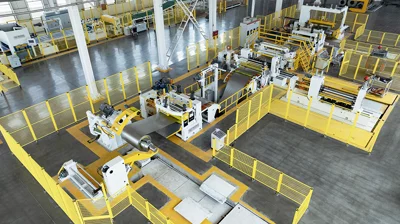
Sheet metal used in home appliances is somewhat different from that used in automotive and 3C applications. Parts such as refrigerator side panels, washing machine housings, and air conditioner panels are relatively large in size, but their precision requirements are not as stringent as those for automotive body panels. Instead, the requirements for surface quality and sheet flatness are actually higher. This is because home appliances are displayed in stores for consumers to see—any waviness or scratch on the housing is visible to the naked eye. Therefore, in the supporting solution for a home appliance sheet metal cut-to-length line, leveling and feeding must be given special attention.
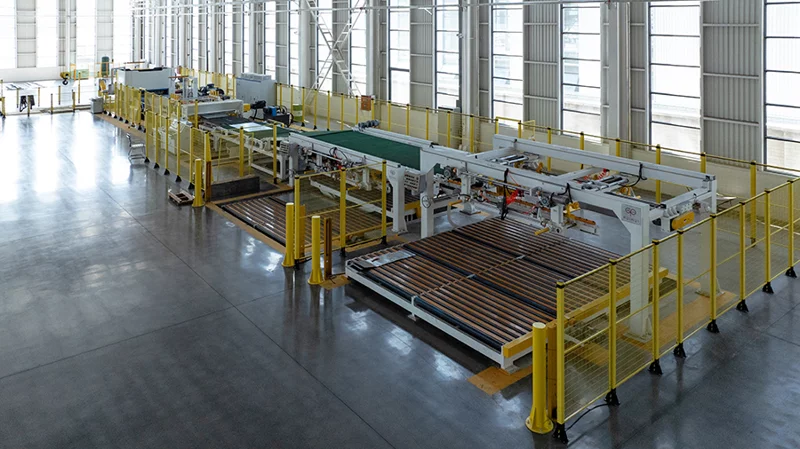
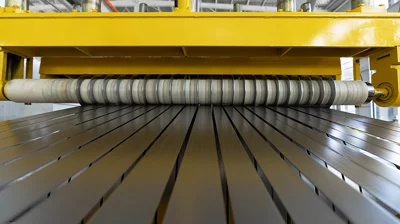
The cut-to-length line itself is responsible for decoiling, leveling, and cutting the coil into individual sheets at fixed lengths. Leveling is the first critical step on the line. If the internal stresses in the coil are not eliminated after decoiling, the cut sheets will be warped or wavy. For home appliance housings, the flatness requirement is generally no more than 1.5 mm of warp per meter, and some high-end products demand even tighter tolerances. The leveling roll configuration must be adequate, with roll diameter and roll surface precision both up to standard. If the roll surface roughness is too high, it will leave marks on the sheet surface; if too low, slipping may occur. This balance must be well controlled.
The accuracy of the feeding stage affects the consistency of sheet length. The splicing and assembly of home appliance housings have requirements for sheet length. If the length deviation is too large, alignment during assembly will be off. If the cut-to-length line's feeding mechanism uses servo drive, the cut-to-length accuracy can be controlled within ±0.5 mm, which is sufficient for most home appliance parts. If the product requires higher length accuracy, the manufacturer can be asked to achieve ±0.2 mm or even tighter.
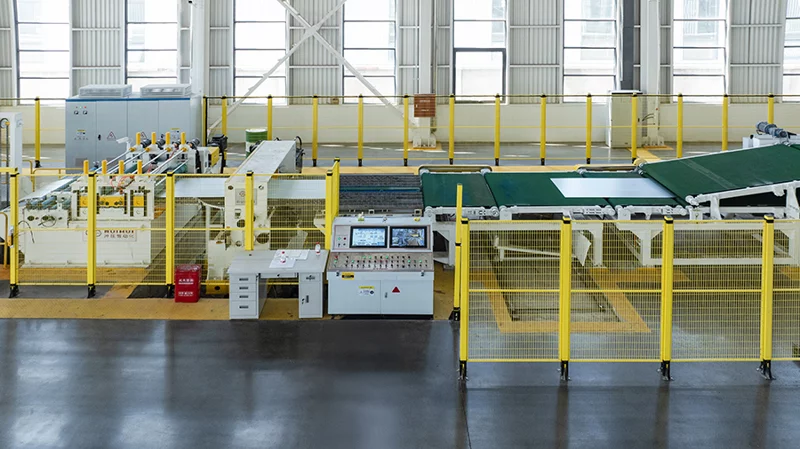
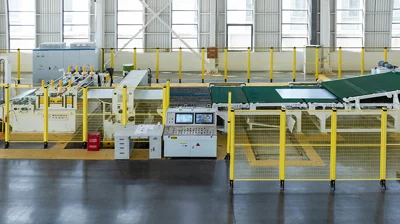
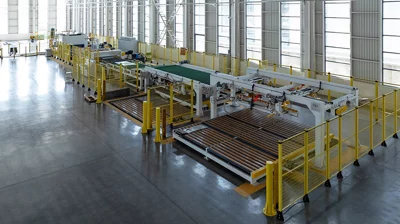
The discharge end of the cut-to-length line should be equipped with a stacking device to automatically stack the sheets neatly after cutting. Home appliance sheets have large surface areas, and manual receiving and stacking are time-consuming and labor-intensive. Moreover, the sheet edges are sharp, and handling them easily causes cuts to the hands. An automatic stacking device catches the sheets, aligns them, and stacks them neatly; workers only need to change the trolley after a stack is full. The neatness of stacking also affects the efficiency of subsequent stamping loading—neatly stacked sheets allow the destacker or manual retrieval to position accurately, reducing the likelihood of two sheets sticking together.
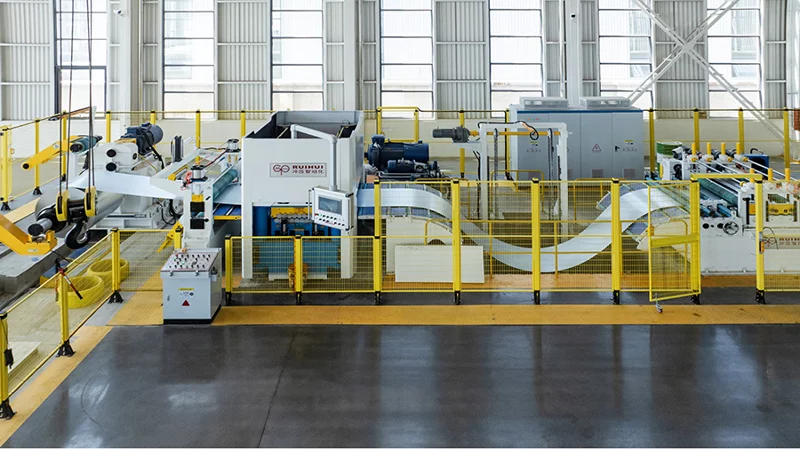
If the cut-to-length line is directly connected to a stamping line downstream, the discharge rhythm of the cut-to-length line must match the loading rhythm of the stamping line. In some factories, the cut-to-length line first cuts a batch of sheets and stacks them, then a forklift transports the stack to the stamping line, where a destacker loads it. In this mode, there is a buffer between the cut-to-length line and the stamping line, so the rhythms do not need to be tightly synchronized. In another mode, the cut-to-length line is directly linked to the stamping line, and the cut sheets go directly into the press. This mode places higher demands on the stability and synchronization of the cut-to-length line.
In home appliance sheet metal cut-to-length scenarios, the most direct improvement from replacing manual labor with automation is in the collection stage. Previously, with manual collection, two workers stood at the end of the line, stacking sheets one after another onto the pile—by the end of the day, their backs would be aching. After the cut-to-length line is equipped with automatic stacking, workers only need to inspect and change trolleys, greatly reducing physical labor. Sheets also no longer need to be handled manually, greatly reducing the risk of surface scratches. Mechanical feeding also provides better dimensional consistency than manual work—every sheet has the same length, making positioning more accurate during subsequent stamping loading.
Guangdong RuiHui Intelligent Technology Co., Ltd. has been deeply engaged in the field of stamping automation for over twenty years. It is a national "Specialized and Sophisticated" "Little Giant" enterprise, headquartered in Dongguan, with more than 400 employees and over 80 R&D personnel. RuiHui has mature configuration experience in leveling and feeding solutions for cut-to-length lines. Tailored to the characteristics of home appliance sheet metal, it has made targeted optimizations in leveling roll systems, servo feeding systems, and automatic stacking solutions. RuiHui has nearly 5,000 sets of equipment operating at customer sites both domestically and internationally, serving well-known OEMs and first-tier suppliers such as BYD, Geely, Volkswagen, Tesla, BMW, Mercedes-Benz, Honda, and Land Rover Jaguar.
With years of hands-on experience, I have honed my skills in navigating the complexities of global commerce, offering invaluable insights and solutions to address customer needs. My commitment to excellence and dedication to customer satisfaction ensure that I deliver exceptional service, guiding clients through every step of the trading process with confidence and proficiency.
You may also like
Related News
Latest Update