

What Is a 3D Transfer Robot Detailed Explanation of Its Pick-and-Place Motion Principle for Multi-Station Operations
Share to : 


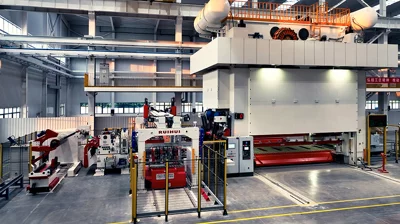
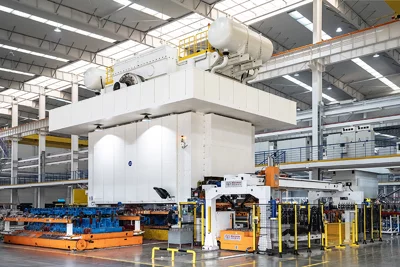
In stamping automation equipment, the 3D transfer robot is the core device of a single-press multi-station stamping line. What does it do? Simply put, within one press, it is responsible for removing a workpiece from the die of one operation and placing it into the die of the next operation. It may sound like just a material handler, but its motion principle and design details determine the efficiency and precision of the entire stamping line.
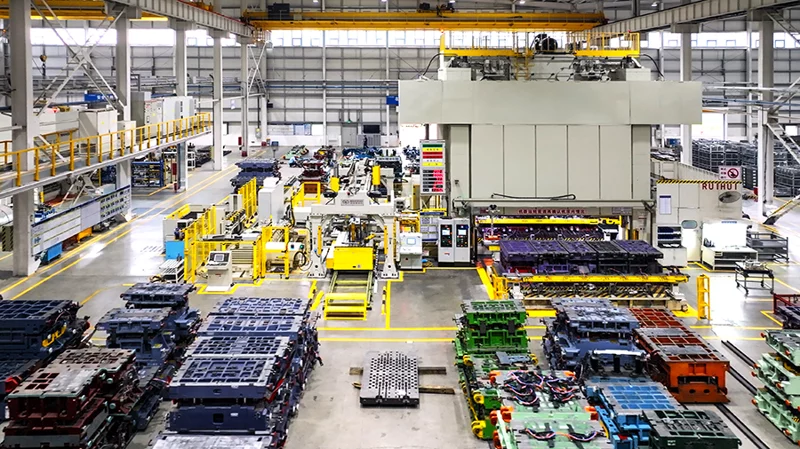
Why is it called a "3D" transfer robot? Because it moves in three-dimensional space, with motion capability in three directions: front-back, left-right, and up-down. The combination of these three directions allows the robot to shuttle freely among multiple stations within a single press. It moves in the X direction (left-right) to carry the workpiece from the previous station to the next; it moves in the Y direction (front-back) to reach into the die area to pick and place parts; and it moves in the Z direction (up-down) to lift the workpiece out of the die and lower it in. The motions in these three directions coordinate with the press cycle, and with one complete sequence, the workpiece completes a transfer between operations.
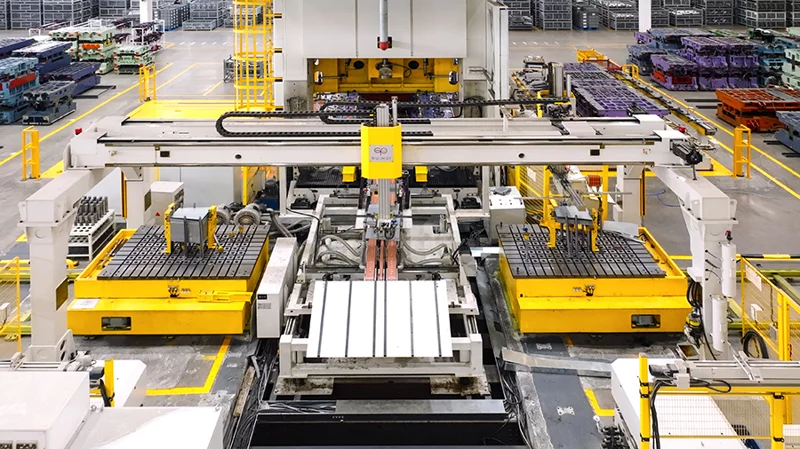
The pick-and-place motions of the 3D transfer robot are strictly coordinated with the press timing. Only after the press has completed its stroke and the slide has risen to the top position is the robot allowed to reach into the die to pick up the part. Only after the robot has removed the workpiece and exited the die area is the press allowed to perform the next stroke. There are safety interlock signals between the robot and the press. This sequence must not be violated—if it is, a die crash will occur. Therefore, timing coordination is one of the most critical aspects of 3D transfer robot design.
The motion mechanism of a 3D transfer robot typically uses servo motor drive plus linear guide rails. Servo motors respond quickly and position accurately; linear guide rails offer high precision and smooth operation. Together, they make the robot's pick-and-place motions fast and precise. The drive system precisely controls the travel distance and speed in each direction according to the program, achieving high repeat positioning accuracy—every pick and place is exactly consistent.
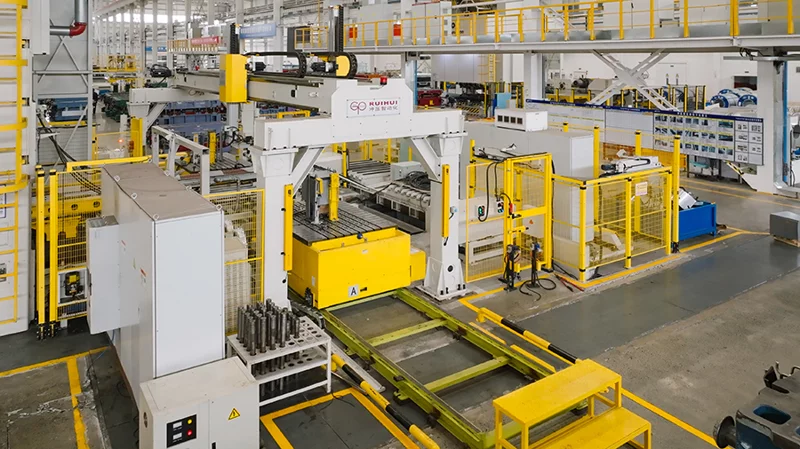
Why is positioning accuracy so important? Because if the workpiece is placed into the die in a different position each time, the stamped product dimensions will deviate, and consistency will suffer. This is the biggest problem with manual loading and unloading—human placement position and force cannot be identical every time. If placed off-center, the stamped part may be out of tolerance. The 3D transfer robot positions precisely and moves consistently, placing every workpiece accurately, ensuring product consistency and reducing rejection rates.
Another characteristic of the 3D transfer robot is its speed. Its motion axes are optimized for low inertia and fast acceleration/deceleration, making the entire pick-transfer-place sequence crisp and efficient. When the press cycle is fast, the robot keeps up, and the overall line production efficiency improves. After automation replaces manual labor, the robot does not tire, maintaining a stable cycle time during continuous operation, achieving much higher output than manual loading and unloading.
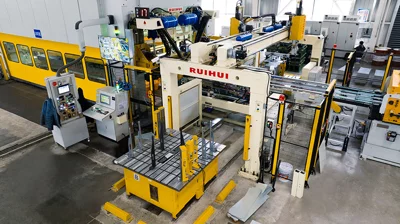
In application, the 3D transfer robot paired with a single-press multi-station stamping line is mainly used for production of small-to-medium multi-operation parts with concentrated processes. Load capacities range from a few kilograms to several hundred kilograms, matching stamping parts of different sizes. At the front end, a feeder or destacker can be provided for automatic loading; at the back end, a collection system automatically gathers finished parts. The entire line, from sheet loading to finished part collection, runs fully automatically.
Guangdong RuiHui Intelligent Technology Co., Ltd. has been deeply engaged in the field of stamping automation for over twenty years. It is a national "Specialized and Sophisticated" "Little Giant" enterprise, headquartered in Dongguan, with more than 400 employees and over 80 R&D personnel. RuiHui's 3D multi-station transfer robots use a three-axis linear motion structure with servo drive and high-precision linear guide rails, offering high repeat positioning accuracy and load capacities ranging from a few kilograms to several hundred kilograms. They have comprehensive safety interlocks with the press and can be linked with feeders, destackers, and collection systems to form a complete stamping automation production line. They are widely used in automotive parts, home appliance sheet metal, 3C hardware, and other industries. RuiHui has nearly 5,000 sets of equipment operating at customer sites both domestically and internationally, serving well-known OEMs and first-tier suppliers such as BYD, Geely, Volkswagen, Tesla, BMW, Mercedes-Benz, Honda, and Land Rover Jaguar, with rich experience in multi-station automation.
With years of hands-on experience, I have honed my skills in navigating the complexities of global commerce, offering invaluable insights and solutions to address customer needs. My commitment to excellence and dedication to customer satisfaction ensure that I deliver exceptional service, guiding clients through every step of the trading process with confidence and proficiency.
You may also like
Related News
Latest Update