

What Is a Single Press Multi Station Stamping Line and How Does One Press Complete Multiple Operations
Share to : 


Those in the stamping industry may often hear the term "single-press multi-station." Especially when visiting large factories, seeing a huge press produce a finished part in just a few minutes with a series of rhythmic strokes—completing several operations in one station—many wonder: how is this achieved? Today, let's clarify this matter.
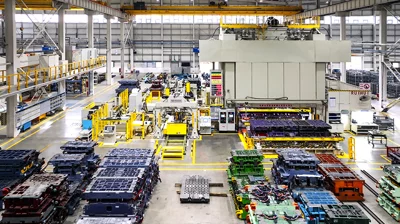
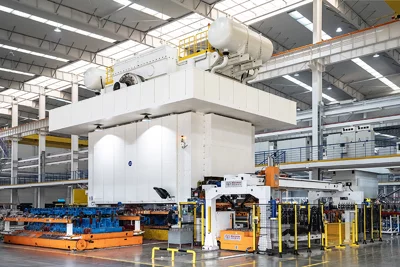
A single-press multi-station stamping line, put simply, is "packing several operations into one press." In traditional stamping, operations such as drawing, trimming, piercing, and flanging might need to be completed sequentially on several presses, with material handled once after each operation. Multi-station is different: all the operation dies are mounted on the same large press. Inside the press, a transfer robot moves the workpiece from the first station to the last station in sequence. With each stroke, all stations work simultaneously—station 1 performs the first operation, station 2 performs the second, station 3 performs the third... After one cycle of the press, a finished part comes out.
The key to achieving all this is the coordinated operation of three parts.
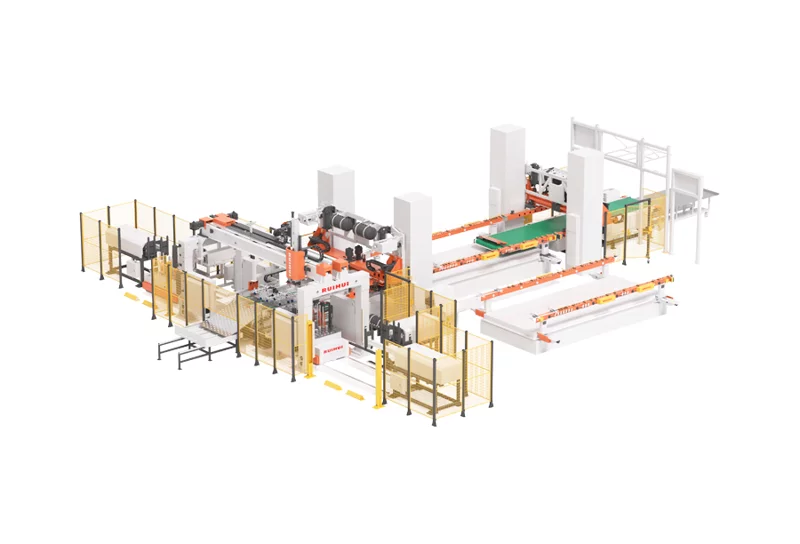
The first is the multi-station die. This is the core of the core. A multi-station die is not a single die but a combination of several dies mounted on one large die base. Each station handles one operation: the first station draws, the second trims, the third pierces, the fourth flanges, and so on. The spacing between stations is fixed and matches the transfer robot's pitch. When arranging the dies, the material deformation behavior between operations and the feed pitch must be considered. If the pitch is too large, material is wasted; if too small, the dies won't fit. Engineers who design multi-station dies must understand stamping processes, die structures, and material flow—it is one of the most technically demanding positions in the stamping industry.
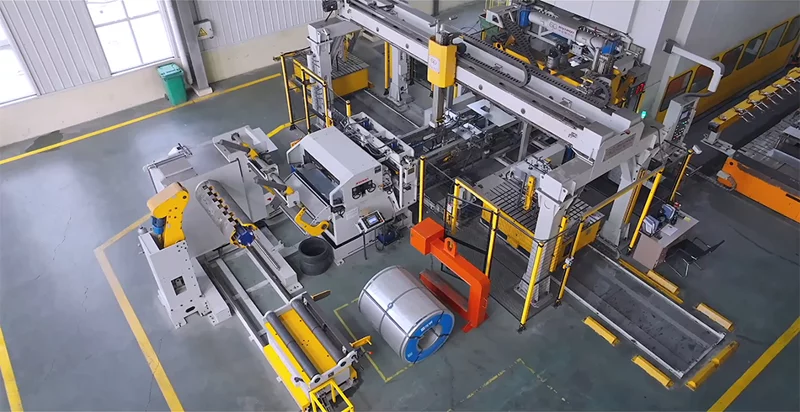
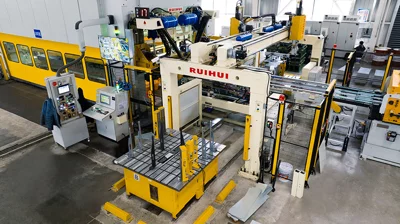
The second is the 3D transfer robot. It handles the transfer of workpieces between stations. The 3D transfer robot has three-axis motion capability: X (horizontal transfer), Y (up/down pick-and-place), and Z (forward/backward reach). The gripper reaches into the die, clamps the workpiece, retracts, moves laterally to the next station, reaches in again, places the workpiece in position, and retracts. The sequence, speed, and force of each motion must coordinate perfectly with the press stroke. The 3D transfer robot is the "handling specialist" in a single-press multi-station line—without it, workpieces cannot move between operations.
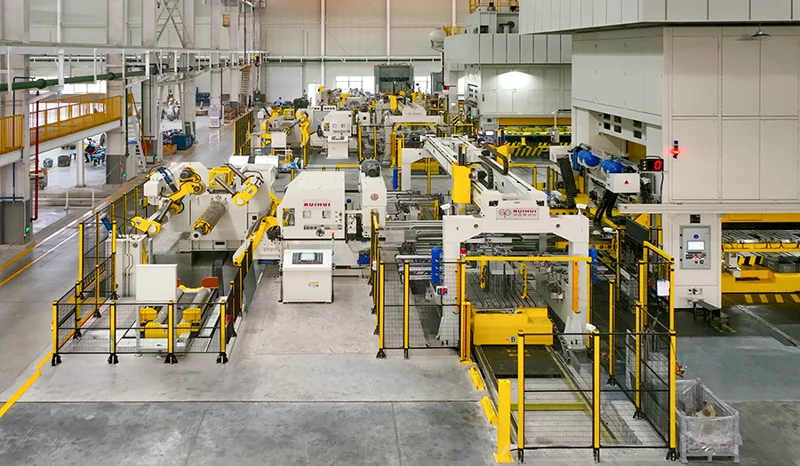
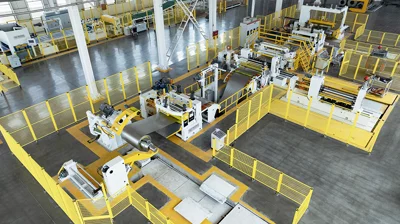
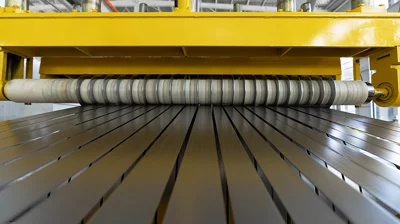
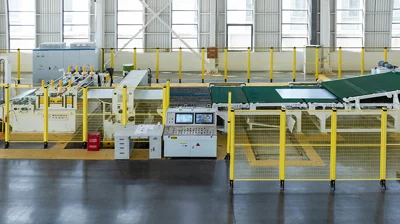
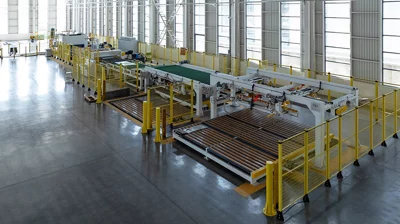
The third is the feeding system. How does coil become sheet, and how is the sheet fed into the first station? This requires coordination with a front-end three-in-one feeder or cut-to-length line. The coil is decoiled, leveled, and fed at the set length to the first station's position; then the 3D transfer robot begins its transfer cycle. The feeding system and the robot must also exchange signals—"material delivered" and "material removed." If these two signals are even slightly out of sync, either a die crash or an idle stroke will occur.
The advantages of a single-press multi-station line are obvious. All operations are completed within one press, so the transfer distance and time between operations are short, and the production line footprint is small. Precision is also easier to control—unlike a multi-press tandem line, where workpieces are repositioned during handling, introducing errors. One press, one die set, one robot—it runs stably and reliably. But the trade-off is also clear: changeover and setup are complex. Changing dies may take several hours or even longer, so multi-station lines are not suitable for small-batch, high-mix production. They are suited for large-volume, relatively fixed products. Automotive body panels, home appliance panels, motor housings—many of these high-volume products are produced on single-press multi-station lines.
So how exactly is "one press completing multiple operations" achieved? Returning to the opening description: all stations are mounted on the same press, the robot transfers synchronously, and with each press cycle, each station completes one operation. The first cycle does not produce a finished part, but once the cycle is established, every subsequent cycle produces one finished part. One press, one die set, one robot group—linked together, they form an efficiently operating multi-station stamping line.
Single-press multi-station stamping lines are suitable for large-volume, stable production, especially for cases with many operations per part, high dimensional accuracy requirements, and difficult manual handling. When selecting, consider whether the product shape is suitable for multi-station arrangement, whether the die structure is feasible, and whether the press tonnage is sufficient. Confirming these points before starting the project is the safer approach.
Guangdong RuiHui Intelligent Technology Co., Ltd. has been deeply engaged in the field of stamping automation for over twenty years. It is a national "Specialized and Sophisticated" "Little Giant" enterprise, headquartered in Dongguan, with more than 400 employees and over 80 R&D personnel. RuiHui's 3D transfer robots are the core handling equipment for single-press multi-station lines. Working with multi-station dies and front-end feeding systems, they enable continuous multi-operation stamping within one press. They have numerous mature applications in the production of high-volume products such as automotive body panels and home appliance panels. RuiHui has nearly 5,000 sets of equipment operating at customer sites both domestically and internationally, serving well-known OEMs and first-tier suppliers such as BYD, Geely, Volkswagen, Tesla, BMW, Mercedes-Benz, Honda, and Land Rover Jaguar, with rich experience in multi-station stamping.
With years of hands-on experience, I have honed my skills in navigating the complexities of global commerce, offering invaluable insights and solutions to address customer needs. My commitment to excellence and dedication to customer satisfaction ensure that I deliver exceptional service, guiding clients through every step of the trading process with confidence and proficiency.
You may also like
Related News
Latest Update