

Understanding Three Different Type of Transfer Systems in Metal Stamping
Share to : 


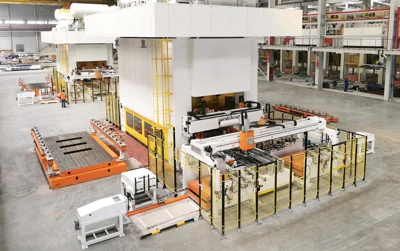
In automated stamping production, the transfer system plays a crucial role, responsible for precisely transferring workpieces from one station to the next during the stamping process. The performance of the transfer system directly affects the production cycle time and workpiece quality. Based on the motion axes, common include 2-axis transfer systems, 3-axis transfer systems, and 6-axis robot systems. This article will help you understand these three different transfer systems.
2-Axis Transfer System
Overview
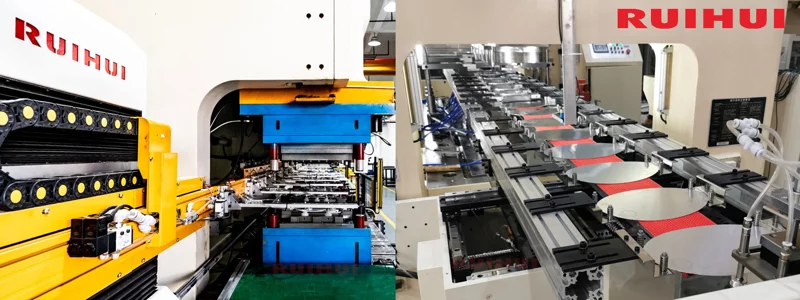 (This is a single crossbar and dual-crossbar 2-axis transfer. You can see the dual-crossbar transfer is close to the worktable and has no lifting.)
A 2-axis transfer system can be designed with a single crossbar, enabling forward–backward motion (feeding) and up–down motion (lifting/releasing). Workpieces are usually handled by vacuum suction cups. It can also be designed a dual-crossbar, in which the left and right crossbeams perform forward–backward motion (feeding) and left–right motion (gripping) to transfer the workpieces.
Features
1. Simple structure, fast transfer.
2. Relatively low cost and relatively easy maintenance.
3. Suitable for the production of small to medium-sized, simply shaped workpieces.
Stamping Lines
Independent manipulator stamping line, connecting rod type manipulator stamping line, 2-axis transfer stamping line.
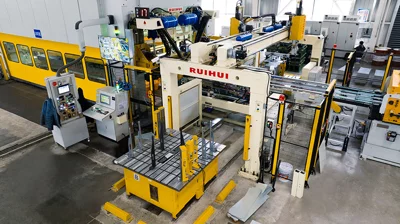
(Here is the connecting rod type manipulator stamping line. The manipulator is fixed to the connecting rod, and the connecting rod moves.)
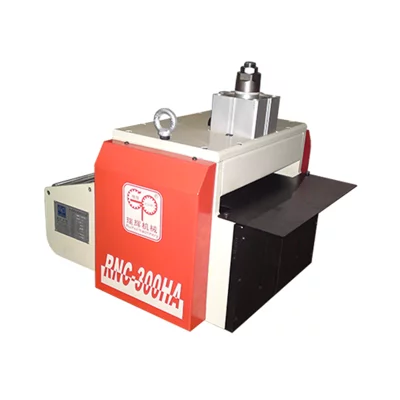
(Here is the 2-axis transfer stamping line. You can see an NC straightener feeder with oscillating function. After blanking, the 2-axis transfer system further transports the workpiece for stamping.)
3-Axis Transfer System
Overview
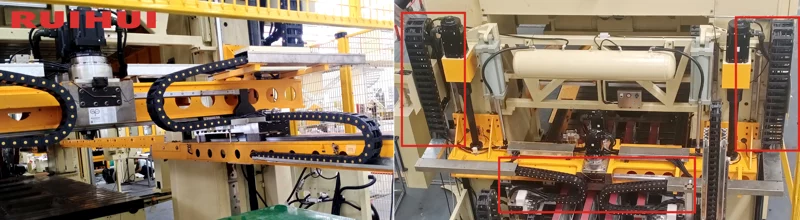 (Here is a 3-axis transfer system. Compared to the 2-axis transfer system, it can move upwards and downwards.)
The 3-axis transfer system is the most commonly used in automated stamping production. It typically uses two horizontal bars to complete forward/backward (feeding), rise/down (releasing), and left/right (clamping) movements.
Features
1. High structural rigidity, enabling stable transport of large and heavy workpieces.
2. Suitable for the production of medium to large-sized, complex-shaped workpieces.
Stamping Lines
truss destacker 3-axis transfer stamping line, top suction destacker 3-axis transfer stamping line, compound 3-axis transfer stamping line.
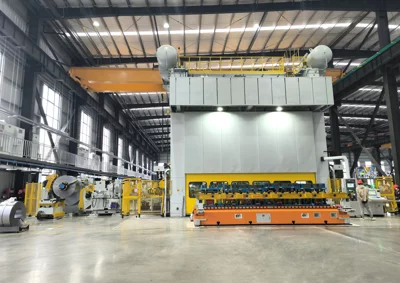
(Here is the 3-axis transfer stamping line.)
6-Axis Robot System
Overview
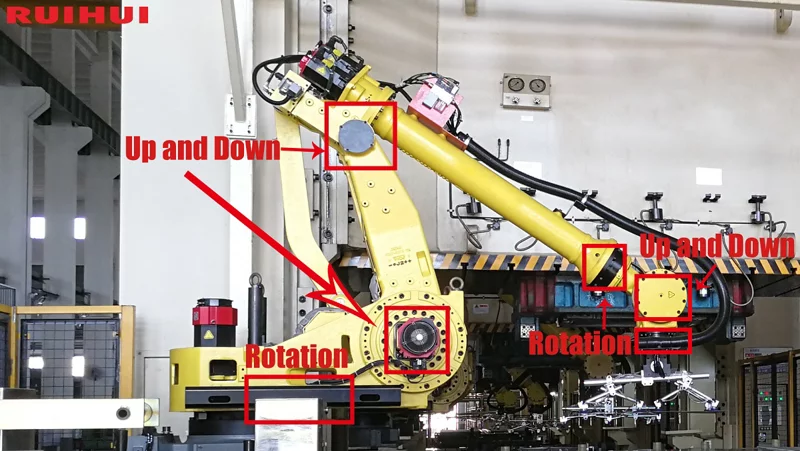 (Here is the 6-axis robot motion joints)
A 6-axis robot has six independently movable joint axes, making it as flexible as an arm. It typically consists of a base, lower arm, upper arm, wrist, and end effector. Specific movements include: base rotation, lower arm pitch, upper arm pitch, wrist pitch, wrist rotation, and end effector rotation.
Features
1. High mobility, capable of performing more actions, such as workpiece flipping, insertion and removal at different angles.
2. Automated mold changing for different types of workpieces, reducing manual intervention.
3. Suitable for producing more complex and larger deep-drawn workpieces.
Stamping Lines
(Here is the 6-axis robot stamping line.)
(Here is a comparison of three transfer systems.)
| Item | 2-axis Transfer System | 3-axis Transfer System | 6-axis Robot System |
| Cost | Relatively low | Moderate | High |
| Speed | Fast | Moderate | Relatively slow |
| Flexibility | General | Moderate | High |
| Maintenance & Setup | Easy | Moderate | Difficult |
With years of hands-on experience, I have honed my skills in navigating the complexities of global commerce, offering invaluable insights and solutions to address customer needs. My commitment to excellence and dedication to customer satisfaction ensure that I deliver exceptional service, guiding clients through every step of the trading process with confidence and proficiency.